
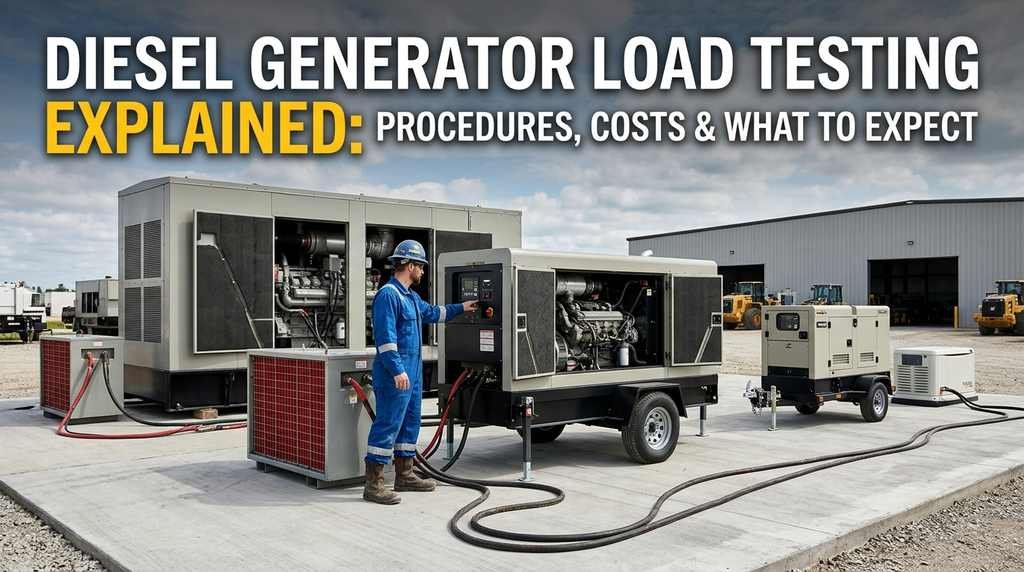


If you own a standby, commercial, rental, or industrial diesel generator, I do not assume it is ready just because the engine starts every week. A generator can idle perfectly and still fail when a large load is applied. That failure can come from fuel restriction, cooling problems, a weak alternator, poor voltage regulation, governor instability, wet stacking, or an overloaded system.
In this guide, I’ll explain diesel generator load testing in practical terms: what a load bank is, when I recommend testing, how technicians usually perform the procedure, what numbers are recorded, what problems the test can reveal, how much load testing can cost, and what I expect to receive in the final report.
Diesel Generator Load Testing Explained: Quick Overview
| Item | What it means |
|---|---|
| Purpose | Verify that the generator can carry a controlled electrical load safely and reliably |
| Typical equipment | Resistive or resistive/reactive load bank, cables, meters, data logging equipment |
| Common test loads | 25%, 50%, 75%, and 100% of rated output, depending on the test plan |
| What gets monitored | Voltage, frequency, current, kW, engine temperature, oil pressure, battery voltage, exhaust, alarms |
| Typical duration | About 2–4 hours including setup for many service jobs; compliance tests may take longer |
| Main benefit | Finds problems that do not appear during unloaded exercise runs |
| Who should perform it | Qualified generator technicians or electricians using properly rated equipment |
What Is a Load Bank?
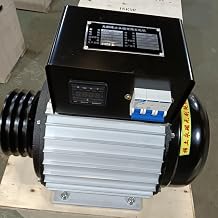
A load bank is a piece of test equipment that creates an artificial electrical demand. Instead of waiting for your building, motors, lights, pumps, HVAC, or production equipment to create enough load naturally, the load bank gives the generator a controlled load on demand.
I think of it as a controlled workout for the generator. If I want to know whether a 100 kW generator can actually deliver 100 kW, I need to make it work under a meaningful load while I watch how the engine and alternator respond.
Cummins describes load banks as devices used to apply electrical load to generators and UPS systems so the power source can be tested under realistic demand. Cummins also points out that load-bank testing can verify emergency reliability without risking the facility’s critical load.


Why I Do Not Rely on No-Load Exercise Alone
A weekly or monthly automatic exercise is useful. It proves that the battery can crank the engine, the starter works, fuel reaches the engine, and the controller can complete a basic run cycle.
But that is not the same as proving the generator can carry its rated electrical load.
A no-load run may not expose a weak radiator, restricted fuel filter, unstable governor, faulty voltage regulator, alternator problem, bad connection, or insufficient fuel flow. It can also allow a diesel engine to spend too much time at low operating temperature.
Caterpillar identifies prolonged operation below roughly 30% of rated load as a common contributor to wet stacking. Cummins also recommends periodic load-bank use for engines that operate for long periods at light or no load.
If you want the broader testing sequence, see my guide on how to test if your diesel generator is working properly.
What Is Wet Stacking?
Wet stacking is one of the reasons load testing gets so much attention with diesel generators. When a diesel engine operates lightly loaded for long periods, combustion temperatures may stay too low. Unburned fuel and carbon can accumulate in the exhaust system.
I may see black, oily-looking residue around exhaust joints, excessive smoke, or carbon buildup. That does not automatically mean the engine is ruined, but it tells me the generator may be spending too much time underloaded.
Caterpillar says prolonged operation below approximately 30% rated load can contribute to wet stacking. Cummins similarly recommends applying increasing load over time to help bring the engine to proper operating temperature and reduce the effects of wet stacking.
Types of Generator Load Banks
Not every load bank tests the same thing. The two types I see most often are resistive and resistive/reactive.
| Load-bank type | What it simulates | Best use |
|---|---|---|
| Resistive | Primarily kW load at near-unity power factor | Engine loading, basic alternator output, routine maintenance testing |
| Reactive / inductive | kVAR and lower power-factor conditions | Motor-heavy systems, transformer-type loads, more realistic kVA testing |
| Resistive/reactive | Combination of kW and kVAR | Commercial and industrial systems where power factor matters |
| Capacitive | Leading power-factor characteristics | Specialized applications |
United Rentals currently lists load banks from small rack-mounted units to networkable systems rated in the hundreds or thousands of kilowatts. Their current fleet includes resistive units around 100, 125, 265, 400, 600, 1,000, 1,250, 2,500, and 3,000 kW, plus larger resistive/reactive and capacitive options.


The load bank must match the generator’s voltage, phase, frequency, and capacity. A 480-volt three-phase industrial set requires very different test equipment from a small 120/240-volt single-phase generator.
Technical Details I Check Before a Load Test
| Technical detail | Why I check it |
|---|---|
| Generator rated kW | Determines target load-bank capacity |
| Generator rated kVA | Important when reactive load and power factor are involved |
| Voltage | Load bank and cabling must match the generator output configuration |
| Phase | Single-phase and three-phase setups require different connections and measurements |
| Frequency | Usually 50 Hz or 60 Hz depending on system |
| Power factor | Determines relationship between kW and kVA |
| Duty rating | Standby, prime, or continuous rating affects what the set is designed to do |
| Ambient temperature / altitude | Can affect generator derating and cooling performance |
How a Diesel Generator Load Test Is Usually Performed
I do not treat load-bank testing as a plug-in-and-turn-it-up job. The technician should follow a structured process.
1. Pre-Test Inspection
Before connecting a load bank, I inspect the generator for obvious reasons not to proceed. That includes fuel level, engine oil, coolant, battery condition, leaks, damaged cables, air intake restriction, radiator blockage, exhaust condition, controller faults, and emergency-stop status.
If there is a fuel leak, coolant leak, low oil condition, damaged conductor, or serious active fault, I do not move directly into a full-load test.
2. Confirm the Electrical Configuration
The technician confirms the generator output voltage, phase, frequency, neutral arrangement, breaker rating, and connection method. The load bank must be configured correctly before it is connected.
This is not a DIY step. Large load banks use high-current cables and can involve dangerous voltages. I leave final connections, phase checks, and energized measurements to qualified personnel.
3. Start and Warm the Generator
The engine is started and allowed to stabilize. During warm-up, I watch oil pressure, coolant temperature, battery charging, frequency, voltage, smoke, sound, and vibration.
If the generator is already behaving abnormally at no load, I do not force it into a heavy-load test just to see what happens.
4. Apply Load in Steps
Many service procedures apply load gradually rather than jumping immediately to 100%.
| Generator rating | 25% load | 50% load | 75% load | 100% load |
|---|---|---|---|---|
| 20 kW | 5 kW | 10 kW | 15 kW | 20 kW |
| 50 kW | 12.5 kW | 25 kW | 37.5 kW | 50 kW |
| 100 kW | 25 kW | 50 kW | 75 kW | 100 kW |
| 250 kW | 62.5 kW | 125 kW | 187.5 kW | 250 kW |
| 500 kW | 125 kW | 250 kW | 375 kW | 500 kW |
Those percentages are simple arithmetic examples, not a universal mandatory test sequence. Caterpillar uses multiple stepped-load patterns in its generator testing work, and field procedures can vary by manufacturer, facility requirements, or applicable standards.
5. Hold the Generator at Each Load Level
At each step, I want enough time to see whether the generator stabilizes. The technician records readings and watches for temperature rise, smoke, fuel starvation, frequency droop, voltage instability, vibration, or alarms.
A current Philippine generator-service procedure published by Powercity uses a two-hour load-bank sequence with staged loading and a final sustained 100% portion. That is one example of how a field acceptance test can be structured; other test plans can be shorter or much longer.
6. Cool Down and Inspect Again
After the test, the load is reduced and the engine is allowed to cool according to the manufacturer’s procedure. I then inspect for leaks, hot spots, alarms, loose connections, unusual smells, and any new fault codes.
What Measurements Are Recorded?
A useful load-bank test gives me data, not just a statement saying “passed.”
| Measurement | What it tells me |
|---|---|
| Voltage | Whether the alternator and regulator maintain proper output as load changes |
| Frequency | Whether engine speed/governor control remains stable |
| Current per phase | Load balance and electrical demand |
| kW | Actual real power being delivered |
| kVA | Apparent power on systems where reactive load matters |
| Power factor | Relationship between kW and kVA |
| Oil pressure | Engine lubrication condition under load |
| Coolant temperature | Cooling-system performance |
| Battery / charging voltage | Starting and control-power health |
| Exhaust condition | Smoke, wet stacking, combustion clues |
I compare those readings with the manufacturer’s specifications, not generic internet limits. A healthy reading for one engine or controller may be wrong for another.
What Problems Can a Load Test Reveal?
This is where the test earns its value. Problems that hide during idle operation often become obvious under load.
| Problem found during load test | Possible cause |
|---|---|
| Voltage drops too far | AVR, alternator, wiring, connection, or overload issue |
| Frequency falls and does not recover | Fuel restriction, governor problem, overload, weak engine output |
| Coolant temperature keeps rising | Blocked radiator, low coolant, fan issue, poor ventilation |
| Heavy black smoke | Overload, restricted intake, injector/fuel problem |
| Engine surges or hunts | Governor or fuel-control instability |
| Breaker trips | Overload, electrical fault, incorrect breaker/application |
| Fuel pressure drops | Restricted filter, blocked pickup, undersized fuel supply |
| Oil pressure falls abnormally | Oil level, viscosity, wear, pump, or temperature-related issue |
For more failure modes, see Common Problems With Diesel Generators and How to Prevent Them.
How Long Does a Load Bank Test Take?
For many commercial service calls, I would expect roughly two to four hours from setup through pack-up, but the actual duration depends on generator size, test standard, access, cabling, required load duration, and whether problems appear.
One current generator-service provider describes a typical sequence of about 30–60 minutes for setup, 15–30 minutes for warm-up, 15–30 minutes at each stepped load, then cool-down and disconnection. Larger compliance tests can take substantially longer.
| Activity | Typical planning time |
|---|---|
| Load-bank setup and cabling | 30–60 minutes |
| Generator warm-up | 15–30 minutes |
| Stepped load testing | 1–3+ hours depending on procedure |
| Cool-down and final inspection | 15–30 minutes |
| Disconnect / pack-up | About 30 minutes |
These are planning ranges, not requirements. Hospitals, data centers, life-safety systems, commissioning projects, and contract acceptance tests may require longer documented test periods.
How Much Does Diesel Generator Load Testing Cost?
There is no national fixed price. I treat any price table as a planning guide because travel, load-bank size, test duration, cabling, access, fuel burn, technician count, reactive-load requirements, and documentation can change the quote significantly.
Current U.S. service-provider examples put small residential or light-commercial tests in the hundreds to around a thousand dollars, while larger commercial and industrial tests commonly move into the low thousands.
| Generator size / service level | Illustrative 2026 planning range |
|---|---|
| Small residential / light commercial | About $500–$1,000 |
| Commercial up to roughly 500 kW | About $1,000–$3,500 |
| 500–1,000 kW | About $2,500–$5,000 |
| 1,000 kW and above | About $4,000–$8,000+ depending on logistics |
These are broad market examples, not guaranteed prices. One current Chicago-area provider publishes $750 for a two-hour test on generators up to 100 kW, plus mileage, while another U.S. generator-service provider quotes approximately $500–$1,000 for residential testing and $1,000–$3,000+ for commercial/industrial work. Complex sites can cost more.
What Makes the Price Go Up?
| Cost factor | Why it increases price |
|---|---|
| Higher kW rating | Larger or multiple load banks are required |
| Reactive testing | Equipment is more specialized than a basic resistive bank |
| Remote location | Travel and mobilization costs rise |
| Rooftop / difficult access | More labor, cable routing, or rigging may be needed |
| Long test duration | More technician time and fuel consumption |
| Formal compliance report | Additional instrumentation, documentation, and review |
| Emergency / short-notice service | Premium scheduling and logistics |
How Much Fuel Does a Load Test Use?
Fuel burn depends heavily on generator size, engine model, and load. I do not estimate fuel cost from generator kW alone when I can get the manufacturer’s fuel-consumption curve.
As an example of why this matters, Sunbelt currently lists one 100 kW diesel rental generator at approximately 7.3 gallons per hour at full load. A two-hour full-load run at that published rate would use about 14.6 gallons. A different 100 kW generator could consume a different amount.
| Example full-load fuel rate | 1 hour | 2 hours | 4 hours |
|---|---|---|---|
| 3 gal/hr | 3 gal | 6 gal | 12 gal |
| 5 gal/hr | 5 gal | 10 gal | 20 gal |
| 7.3 gal/hr | 7.3 gal | 14.6 gal | 29.2 gal |
| 10 gal/hr | 10 gal | 20 gal | 40 gal |
Those are simple arithmetic examples. The actual test often spends only part of the time at full load, so total fuel use depends on the specific sequence.
When Should I Schedule Load Testing?
I consider load-bank testing when a generator spends most of its life at light load, after major repairs, during commissioning, before buying a used generator, after a long period of inactivity, or when a facility needs documented proof of capacity.
For critical facilities, the maintenance plan may specify testing at defined intervals. Cummins recommends incorporating load-bank testing into generator maintenance programs, particularly where low-load operation can contribute to wet stacking.
If you are building a routine service plan, also read Diesel Generator Maintenance: What You Need to Know and How Often Should Diesel Generators Be Serviced?.
Load Bank Test vs. Building Load Test
A building-load test uses your actual facility as the load. A load bank uses artificial controlled demand. Both can be useful, but they prove slightly different things.
| Test type | Advantage | Limitation |
|---|---|---|
| Building load | Tests the actual transfer path and real equipment | Load may be too low or unpredictable |
| Resistive load bank | Controlled, repeatable kW loading | Does not fully reproduce every motor/reactive load |
| Resistive/reactive load bank | More realistic kVA and power-factor testing | Higher cost and more specialized equipment |
If I want to prove that the generator can carry the actual building and the automatic transfer switch works correctly, I may combine transfer testing with load-bank work rather than treating them as the same test.
What Should Be in the Final Load-Test Report?
I want a written report that I can compare with future tests. At minimum, I expect the generator model and serial number, rated kW/kVA, voltage and phase, date, ambient conditions, operating hours, load steps, readings, alarms, observations, and technician recommendations.
I also want any abnormal behavior documented: smoke, leaks, overheating, unstable voltage, frequency droop, unusual vibration, or breaker operation.
Cummins notes that performance testing results can be documented and communicated in writing. That record becomes especially useful for maintenance planning, warranty discussions, insurance documentation, and facility audits.
What Happens If the Generator Fails the Test?
I do not automatically assume the entire generator is bad. A failed load test tells me where the system needs diagnosis.
If the voltage falls but frequency stays normal, I look more toward the alternator, AVR, wiring, or electrical side. If both frequency and engine speed fall, I look harder at fuel delivery, engine output, governor control, or overload. If coolant temperature climbs steadily, I investigate the cooling system and airflow.
After repairs, I prefer to retest under the same or a comparable load so I can verify the correction.
Can I Do Load Bank Testing Myself?
For anything beyond a very small purpose-built generator and manufacturer-approved test method, I recommend professional testing.
A commercial load bank can involve hundreds or thousands of amps, high fault current, hot exhaust, hot load-bank discharge air, heavy cables, and dangerous voltages. Incorrect connection can damage the generator, start a fire, or cause serious electrical injury.
I am comfortable with visual inspections, controller readings, and routine owner-level checks. I leave load-bank cable sizing, connection, phase verification, live metering, and high-current testing to qualified personnel.
Frequently Asked Questions
What is a diesel generator load test?
It is a controlled test in which electrical load is applied to the generator while technicians monitor engine and electrical performance. The goal is to prove that the generator can carry meaningful demand without overheating, tripping, producing unstable voltage/frequency, or developing other faults.
Does a generator need to be tested at 100% load?
Not every maintenance test requires 100% load. The correct target depends on the manufacturer, facility standard, duty rating, and reason for testing. Some procedures use stepped loading up to full rated output, while other exercise requirements focus on lower minimum load levels.
What is the difference between a resistive and reactive load bank?
A resistive bank mainly tests real power in kW at near-unity power factor. Reactive or resistive/reactive banks add inductive load so technicians can test kVA and power-factor behavior more realistically.
How often should a diesel generator be load-bank tested?
There is no one interval for every generator. I base it on manufacturer guidance, facility requirements, how heavily the generator normally runs, whether it has a history of low-load operation, and how critical the backup power is.
Can load testing damage a generator?
A properly planned test should stay within the generator’s rating and manufacturer limits. The test may reveal an existing weakness, but that is very different from deliberately overloading the generator.
How much does a load-bank test cost?
Small systems may cost several hundred dollars, while larger commercial and industrial tests commonly cost $1,000 to several thousand dollars. Location, capacity, test duration, fuel, access, and reactive testing can all affect the quote.
My Bottom Line
When I want to know whether a diesel generator is truly ready for an outage, load testing gives me information that a simple start-and-idle exercise cannot.
A good load-bank test applies controlled demand, records voltage and frequency, watches engine temperature and oil pressure, checks fuel and cooling performance, and proves whether the generator can remain stable as load rises.
I also see load testing as preventive maintenance. It can expose weak components before an outage, help manage low-load diesel operation, and create a documented performance baseline for future service.
If your generator is critical to a business, home, healthcare facility, jobsite, or emergency system, I would rather discover a cooling, fuel, alternator, or control problem during a planned test than during the outage when the generator is your only power source.
Sources and Technical References
I reviewed current information from Cummins load-bank performance testing guidance, Caterpillar wet-stacking guidance, United Rentals load-bank specifications, and current field-testing information from generator service providers. Exact test duration, load steps, voltage/frequency tolerances, and service intervals should follow the generator manufacturer, applicable codes, and the facility’s written maintenance plan.

Pingback: Diesel Generator Run Time: How Long Can a Generator Run Continuously?