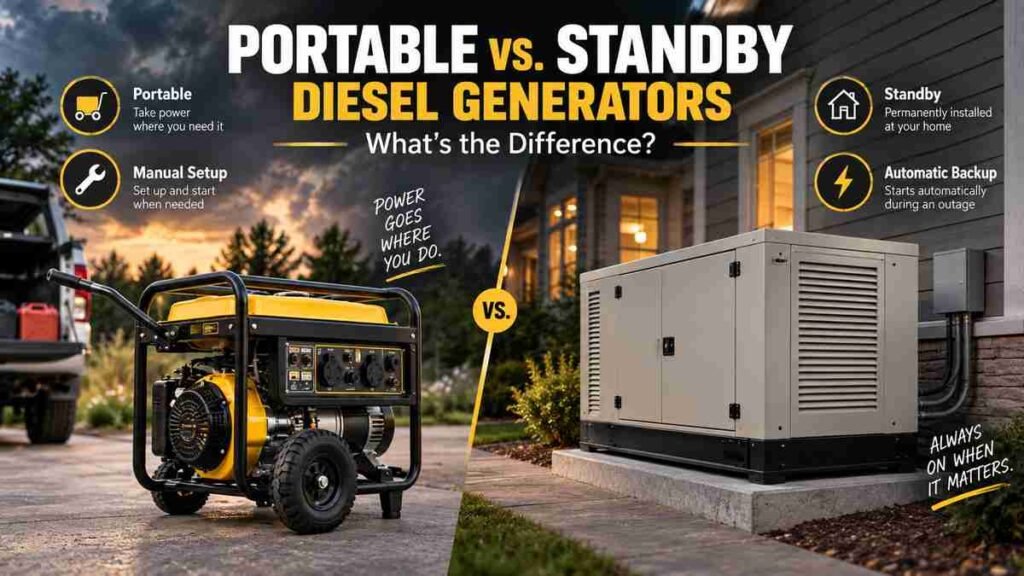
The biggest difference between portable and standby diesel generators is how they are installed and how they deliver backup power. A portable diesel generator is movable and usually requires you to bring it into position, start it, refuel it, and connect loads manually. A standby diesel generator is permanently installed, connected to your home or building through a transfer switch, and can start automatically when utility power fails. If you want lower upfront cost and flexibility, I would look at portable diesel. If you want automatic, higher-capacity backup power with less work during an outage, I would look at standby diesel.
I see these two generator types compared as if the only difference were size, but that misses the point. The real differences involve installation, transfer switches, starting method, output, fuel storage, noise, weather protection, maintenance, and how much work you want to do when the lights go out. In this guide, I’ll walk you through those differences in practical terms so you can decide which type makes more sense for your home, workshop, farm, or small business.
Portable vs. Standby Diesel Generators at a Glance
| Feature | Portable Diesel Generator | Standby Diesel Generator |
|---|---|---|
| Installation | Temporary or movable setup | Permanently installed |
| Startup | Usually manual; some have electric start | Usually automatic with an ATS |
| Connection to home | Extension cords or manual transfer switch/inlet | Automatic transfer switch and fixed wiring |
| Typical role | Essential loads, tools, temporary backup | Whole-home or selected-circuit backup |
| Common residential diesel size | Roughly 2–10 kW/kVA for smaller units; larger mobile units exist | Often 15–50 kW in residential/light-commercial diesel lines |
| Fuel supply | Integral tank; manual refueling | Built-in or external bulk tank |
| Weather exposure | Must be operated in a safe outdoor location and protected from rain as directed by the manufacturer | Weather-rated enclosure designed for permanent outdoor installation |
| Mobility | High relative to standby units | None after installation |
| Upfront complexity | Lower | Higher |
| Best fit | Budget-conscious backup, occasional outages, multiple uses | Automatic backup, larger loads, frequent or long outages |
Those ranges are not hard limits. “Portable” can mean anything from a compact open-frame diesel generator to a heavy sound-attenuated unit mounted on wheels or a trailer. Likewise, standby diesel generators can extend far beyond 50 kW. I use the table as a residential decision guide rather than a universal engineering classification.




What Is a Portable Diesel Generator?
A portable diesel generator is a generator set designed to be moved from one location to another instead of being permanently wired into one building. Some are small open-frame units that two people can move. Others are heavy enclosed units that are technically portable because they can be rolled, lifted, or trailer-mounted.
For example, Yanmar’s YDG portable diesel line includes open-type units in the roughly 2.2 to 6.6 kVA range. Multiquip also sells mobile diesel generator sets, including a 6 kW model designed for portable power. That tells you why I do not assume “portable” means lightweight. A commercial portable diesel generator may weigh hundreds of pounds even though it is not permanently installed.
For home backup, the main appeal is flexibility. You can use the same generator for an outage, a detached workshop, a jobsite, a remote property, or equipment away from the house. If you move frequently or you do not want a permanent installation, that flexibility matters.
How I would connect a portable generator to a house
I would not connect a portable generator to a home by improvising a backfeed connection. The safer approach is to power individual appliances with properly rated outdoor extension cords or have a qualified electrician install a proper generator inlet and manual transfer switch or interlock system that is permitted for your installation. A transfer arrangement keeps generator power isolated from utility power and helps prevent dangerous backfeeding.
Generac notes that its manual transfer switches are designed to power selected hard-wired loads such as a furnace, well pump, and lighting, while preventing dangerous backfeeding. The exact hardware you need depends on the generator output, receptacles, home service, local electrical code, and the circuits you plan to support.
What Is a Standby Diesel Generator?
A standby diesel generator is permanently installed at the property and wired into the electrical system. In a typical automatic setup, an automatic transfer switch, or ATS, monitors utility power. When utility service fails, the system disconnects the home from the grid, starts the generator, and transfers the electrical load to generator power. When utility power returns and stabilizes, the ATS transfers the load back and the generator shuts down after its cooldown sequence.
This is the key reason I consider a standby generator a completely different ownership experience. You are not dragging equipment outside during a storm, finding cords, filling a small tank, and deciding which appliance gets power first. A properly installed standby system is already in place.
Cummins describes a home standby generator and ATS as an integrated system that automatically switches the home from utility power to generator power during an outage and back again when utility service returns. Generac’s automatic transfer switch documentation describes the same basic isolation and transfer function.
Diesel standby generators are different from the most common home standby units
One point I want to make clear is that many residential standby generators sold today run on natural gas or propane. Diesel standby generators are absolutely available, but they are more common where the owner specifically wants diesel storage, already uses diesel on the property, needs larger capacity, or values the operating characteristics of an industrial-style diesel engine.
Generac, for example, currently offers diesel standby models starting at 15 kW in its Protector line, with larger ratings available. These units are physically much larger and heavier than the portable generators most homeowners picture.
Technical Differences: Portable vs. Standby Diesel Generators
| Technical Detail | Portable Diesel | Standby Diesel | Why It Matters to You |
|---|---|---|---|
| Engine speed | Varies; small air-cooled sets may run at 3,000/3,600 rpm | Many larger residential diesel standby sets run at 1,800 rpm | Engine design affects noise, longevity, service intervals, and cost |
| Voltage | Common home-oriented units may offer 120/240 V single phase | 120/240 V single phase is common for U.S. homes; three-phase options also exist | Must match the building and loads |
| Transfer method | Manual switch, inlet, or individual cords | Automatic transfer switch | Determines whether backup is manual or automatic |
| Starting | Recoil or electric start depending on model | Automatic electric start through controller/ATS | Standby can operate while you are away |
| Enclosure | Open frame or portable sound-attenuated enclosure | Permanent weather/sound enclosure | Affects placement and noise |
| Fuel tank | Usually integral and comparatively small | Integral base tank or separate larger storage tank | Changes runtime and refueling frequency |
| Load strategy | Usually selected appliances or essential circuits | Selected circuits or whole-home service | Changes required kW capacity |
| Monitoring | Usually local/manual | Controllers and remote monitoring are common on modern systems | Useful for unattended backup |
I would treat engine-speed figures as model-specific rather than universal rules. A small air-cooled portable diesel can operate at higher rpm, while many heavy-duty standby systems use lower-speed liquid-cooled engines. Always check the actual data sheet instead of buying on a broad category assumption.
Real-World Size and Specification Examples
To show how different these classes can be, I pulled examples from current or published manufacturer specifications. These are examples, not buying recommendations.
| Example | Type | Published Output | Published Weight | Notable Detail |
|---|---|---|---|---|
| Yanmar YDG6600N | Open portable diesel | Up to 6.6 kVA standby rating at 60 Hz | YDG-series weights vary by model; smaller units can be under 110 kg | Open-frame diesel design |
| Multiquip DCA6SPX4F | Mobile/portable enclosed diesel | 6 kW prime | About 836 lb wet | 120/240 V single phase, 1,800 rpm |
| Generac RD01525 | Permanent standby diesel | 15 kW | About 1,528 lb | 2.5 L engine, 1,800 rpm, automatic standby design |
The Multiquip example is a good reminder that diesel “portable” equipment can still be heavy. Its published full-load fuel consumption is about 0.70 gallon per hour, and its half-load figure is about 0.47 gallon per hour. Those are model-specific values, but they show why I always check the data sheet when estimating runtime instead of applying a generic gallons-per-hour rule to every generator.
| Multiquip DCA6SPX4F Load | Published Diesel Consumption |
|---|---|
| 25% load | 0.37 gal/hr |
| 50% load | 0.47 gal/hr |
| 75% load | 0.58 gal/hr |
| 100% load | 0.70 gal/hr |
If you are sizing a generator for a home, I would not choose based only on the kW number on the label. I would first total the loads you actually want to run, then account for motor-starting surge from equipment such as air conditioners, pumps, refrigerators, and compressors. I explain that process in my diesel generator sizing guide.
1. Automatic Operation Is the Biggest Practical Difference
If you ask me what separates the two types most clearly in everyday life, I would say automation.
With a portable diesel generator, you normally have to recognize the outage, retrieve or position the unit, perform your pre-start checks, connect the load safely, start the engine, and monitor fuel. Even if the generator has electric start, the overall backup process is still usually manual.


With a standby generator, the ATS is designed to do the power-source switching for you. That matters if the outage happens at 2 a.m., during severe weather, while you are traveling, or when someone at home cannot physically move and start a portable generator.
If you have a sump pump, medical equipment, refrigeration, security equipment, communications systems, or other loads that you do not want sitting without power until someone arrives, automatic standby becomes much more attractive.
2. Portable Diesel Usually Wins on Flexibility
I like portable diesel when one machine needs to do several jobs. You may want emergency home power in hurricane season, then use the generator at a workshop or remote property later. A permanent standby generator cannot follow you.
Portability also lets you avoid dedicating permanent outdoor space to a large enclosure and fuel system. That said, you still need a safe operating location, proper cable routing, and a realistic plan for moving the generator. A 6 kW commercial diesel generator can be far heavier than a typical gasoline portable unit.
If you are comparing home-backup models specifically, you may also want to read my guide to the best diesel generators for home backup power, where I separate portable, home-backup, and larger standby applications.
3. Standby Diesel Usually Handles Larger Loads More Naturally
Portable diesel generators can get large, especially trailer-mounted units, but the home-portable category often focuses on essentials rather than full-house operation. A small unit may comfortably run refrigeration, lights, internet equipment, a few outlets, and selected pumps, while struggling if you expect it to start central air conditioning, an electric water heater, an electric range, and a well pump at the same time.
Standby systems are easier to design around larger loads because they are permanently connected and available in higher capacities. Generac’s residential/light-commercial diesel standby line includes 15 kW, 20 kW, 30 kW, and roughly 48–50 kW classes. That gives an installer more room to design for major HVAC, pumps, and other substantial loads.
| Backup Goal | Approximate Planning Range I Would Investigate | Likely Generator Type |
|---|---|---|
| Refrigerator, lights, router, charging, a few outlets | 3–6 kW class | Portable diesel may fit |
| Essentials plus pumps, multiple appliances, small HVAC loads | 6–15 kW class | Large portable or small standby |
| Broad home coverage with central HVAC | 15–30 kW class | Standby usually makes more sense |
| Large home, multiple HVAC systems, pumps, shop or heavy loads | 30–50+ kW class | Standby diesel or engineered system |
Those are planning ranges only. I would never size a permanent generator from square footage or a table alone. Motor starting, electric heat, well pumps, voltage, phase, load management, and simultaneous demand can change the result substantially.
4. Fuel Storage and Runtime Work Differently
A portable diesel generator normally has a built-in tank sized around portability. During a long outage, you may need to shut down and refuel several times. That means you need safely stored fuel and someone available to manage it.
A standby diesel generator can use a much larger integral or external tank. Larger storage is one of diesel standby’s major strengths because you can design the system for extended runtime without depending on a natural gas utility. The trade-off is that diesel storage becomes part of the system. Fuel quality, water contamination, microbial growth, tank inspection, filtration, and fuel turnover all matter.
If I were installing a diesel standby system, I would treat the fuel tank as seriously as the generator itself. A generator that is mechanically perfect will still fail if its fuel supply is contaminated. My guides on water in diesel fuel and diesel storage are useful starting points for that part of the ownership plan.
5. Noise Is Not Simply “Portable Loud, Standby Quiet”
People often assume every portable generator is loud and every standby generator is quiet. I would not rely on that rule.
Open-frame portable diesels can be noisy because the engine and mechanical components are exposed. Enclosed portable units can be much quieter. Standby units usually have purpose-built acoustic/weather enclosures, but a 15–50 kW diesel engine still produces meaningful sound, especially under load.
Placement matters as much as the nameplate. Distance, walls, fences, vegetation, reflective surfaces, exhaust direction, local noise ordinances, and the manufacturer’s clearance requirements can all affect what you hear at the house or property line.
6. Installation Cost Is Much Higher for Standby
A portable generator can be relatively simple if you are only powering a few appliances through proper cords. The price rises if you add a manual transfer switch, inlet box, upgraded wiring, or site work, but it is still usually a simpler project than a permanent standby installation.
A standby diesel system may require the generator, ATS, electrical work, concrete or approved mounting pad, fuel tank and piping, permits, delivery equipment, site access, exhaust clearances, startup commissioning, and sometimes engineering. The generator purchase price is therefore only one part of the installed cost.
I would compare systems by total installed cost rather than generator price alone. A low equipment price can be misleading if installation, fuel storage, and electrical upgrades are substantial.
7. Maintenance Is More Convenient on Standby, but Not Optional
Standby systems are often better at reminding you that they exist. Modern controllers can run exercise cycles, record faults, and support remote monitoring. That does not make them maintenance-free.
Diesel generators need oil and filter service, fuel-system care, battery maintenance, coolant checks on liquid-cooled models, air-filter inspection, and periodic loaded operation. A standby unit that runs unloaded for short exercise cycles may still need proper load testing and maintenance according to its manufacturer and application.
Portable generators can be easier to neglect because they may sit in storage for months. Before outage season, I would confirm the battery is charged if equipped, fuel is clean, filters are serviceable, oil is correct, cables and plugs are intact, and the unit starts and accepts load.
8. Portable Generator Safety Requires More Hands-On Attention
Portable generator safety deserves its own section because placement mistakes can be deadly. Diesel engines produce carbon monoxide just like other internal-combustion generators.
The U.S. Centers for Disease Control and Prevention says portable generators should be operated outdoors, more than 20 feet from windows, doors, and vents. The CDC also recommends battery-powered or battery-backup carbon monoxide detectors in the home. I would never run a portable diesel generator in a garage, basement, carport, or other enclosed or partly enclosed area, even with doors open.
| Portable Generator Safety Item | Practical Rule |
|---|---|
| Distance from home openings | More than 20 ft from windows, doors, and vents per CDC guidance |
| Operating location | Outdoors only; never inside a home or garage |
| CO detection | Use battery-powered or battery-backup CO detectors |
| Electrical connection | Use approved cords or a properly installed transfer method |
| Wet conditions | Follow manufacturer instructions and do not operate electrical equipment where it can become wet |
A permanent standby generator also requires correct placement and exhaust clearances, but those details are addressed during installation. That removes much of the decision-making you would otherwise repeat every time you deploy a portable unit.
Which Is Better for a Home: Portable or Standby Diesel?
I would choose portable diesel if outages are occasional, you mainly want to run essentials, you value mobility, you have someone capable of deploying and refueling the generator, and you want to keep the system relatively simple.
I would choose standby diesel if uninterrupted automatic backup is important, the property has larger electrical loads, outages are frequent or prolonged, the generator may need to start while nobody is home, or the property already stores and manages diesel fuel.
For many ordinary suburban homes, I would also compare diesel standby against natural-gas and propane standby before making the final decision. Diesel is excellent in the right application, but fuel storage and installation are more involved than connecting a gaseous-fuel standby unit where a reliable fuel supply already exists.
Portable vs. Standby Diesel Generator Pros and Cons
| Type | Main Advantages | Main Trade-Offs |
|---|---|---|
| Portable diesel | Movable, lower installation complexity, useful for multiple locations, good for essential loads | Manual setup, manual refueling, more exposure to weather/CO-placement mistakes, usually less convenient |
| Standby diesel | Automatic operation, permanent connection, larger power options, large fuel storage, remote monitoring on many systems | Higher installed cost, permanent site commitment, fuel-system maintenance, professional installation |
My Bottom Line
When I compare portable vs. standby diesel generators, I do not think of one as universally better. I think of them as tools for different backup-power jobs.
A portable diesel generator gives you flexibility. It can be moved, used at multiple locations, and deployed only when you need it. It usually costs less to put into service, but it asks more from you during an outage: moving, connecting, starting, refueling, monitoring, and storing it safely.
A standby diesel generator gives you automation and capacity. It is already connected, can start automatically through an ATS, and can be designed around long outages and larger loads. In return, you accept a more expensive installation, permanent space requirements, and a fuel-storage system that needs ongoing care.
If I were deciding for my own property, I would start with the loads, outage duration, and how automatic I need the backup system to be. Once those three things are clear, the portable-versus-standby decision usually becomes straightforward.
Frequently Asked Questions
What is the main difference between a portable and standby diesel generator?
A portable diesel generator is movable and usually requires manual setup and connection. A standby diesel generator is permanently installed and normally uses an automatic transfer switch so it can start and supply the building automatically during a utility outage.
Are standby diesel generators more powerful?
They often are in residential applications. Small portable diesels commonly occupy the lower-kW range, while residential and light-commercial diesel standby lines can start around 15 kW and extend to 50 kW or more. Large mobile generators can also reach high outputs, so the categories do overlap.
Do portable diesel generators need a transfer switch?
Not if you are only powering individual appliances directly with properly rated cords. If you want to feed hard-wired household circuits through the electrical panel, I would use an approved transfer switch or other code-compliant transfer equipment installed for that purpose.
Will a standby generator start if I am not home?
A properly configured automatic standby system is designed to do exactly that. The automatic transfer switch detects loss of utility power, isolates the home from the grid, starts the generator, and transfers the load without you being present.
How far should a portable diesel generator be from the house?
The CDC says portable generators should be used outdoors more than 20 feet from windows, doors, and vents. I would also follow the generator manufacturer’s placement, exhaust, weather, and clearance instructions.
Which type is better for long outages?
I usually favor standby diesel for long, recurring outages because it can be paired with larger fuel storage and automatic transfer equipment. A portable diesel can also run for extended periods, but someone must monitor it and refuel it safely.
Sources and Further Reading
I checked current manufacturer and safety guidance while preparing this comparison, including CDC carbon-monoxide safety guidance, Generac manual transfer-switch guidance, Generac automatic transfer-switch information, Generac’s 15 kW diesel standby specifications, Yanmar’s YDG6600N specifications, and Multiquip’s published DCA6SPX4F data sheet.