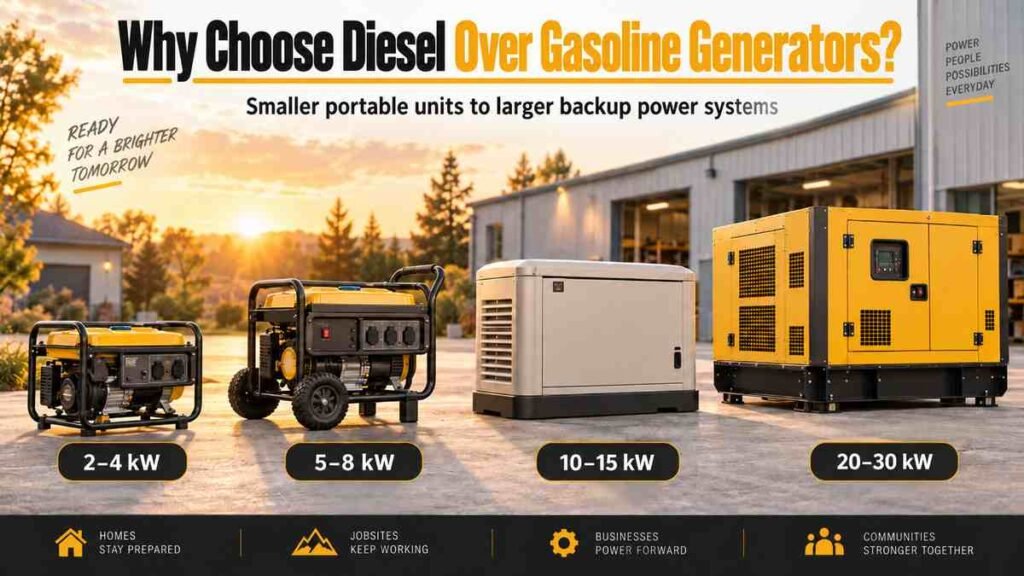
If you are asking why choose diesel over gasoline generators, I would usually point to four things first: diesel gives you more energy per gallon, is well suited to long runtimes and heavy loads, is commonly built into more durable commercial-duty generator sets, and is less volatile than gasoline. I would still choose gasoline in some situations, especially when you want a lighter, cheaper portable generator that only runs occasionally. The right choice depends on how much power you need, how long you expect the generator to run, and whether portability or long-term reliability matters more to you.
I do not think diesel is automatically the best fuel for every generator owner. If I were buying a small emergency unit for a few lights, a refrigerator, and short outages, gasoline can make a lot of sense. But if I expected the generator to run for long periods, support a business, power a large home, carry motor loads, or serve as a serious standby system, diesel would move much higher on my list.
In this guide, I will show you the practical differences between diesel and gasoline generators, where diesel earns its reputation, where gasoline still has an advantage, and how I would decide between them.



Diesel vs. Gasoline Generators: Quick Comparison
| Factor | Diesel Generator | Gasoline Generator |
|---|---|---|
| Engine type | Compression-ignition diesel engine | Spark-ignition gasoline engine |
| Fuel energy per gallon | Higher | Lower |
| Typical strength | Long runtime, heavier loads, commercial and standby use | Portability, lower purchase cost, occasional use |
| Initial purchase price | Usually higher | Usually lower |
| Weight | Usually heavier for comparable output | Usually lighter and easier to move |
| Ignition system | No spark plugs required for combustion | Uses spark plugs and ignition components |
| Fuel volatility | Lower volatility | Higher volatility |
| Best fit | Frequent use, long outages, businesses, larger backup systems | Short outages, portable jobs, camping, light residential backup |
This comparison is a starting point. Generator design matters as much as fuel type. A well-designed gasoline generator can be extremely reliable, and a poorly maintained diesel generator can fail when you need it most.
1. Diesel Packs More Energy Into Each Gallon
One reason I like diesel for extended generator use is simple: there is more energy in a gallon of diesel than in a gallon of motor gasoline. The U.S. Energy Information Administration publishes current heat-content conversion factors that make the difference easy to see.
| Fuel | Approximate Energy Content per U.S. Gallon | Relative Energy Content |
|---|---|---|
| Motor gasoline | 120,214 Btu | Baseline |
| Diesel fuel | 137,381 Btu | About 14% more energy per gallon |
That does not mean every diesel generator will automatically use 14% less fuel than every gasoline generator. Engine efficiency, load percentage, engine speed, alternator efficiency, emissions equipment, temperature, and generator design all matter. Still, diesel starts with an energy-density advantage, and modern compression-ignition engines are well suited to converting that fuel into useful torque under sustained load.
If I am planning for a long outage, I care about how much useful electrical energy I can carry or store on site. Higher fuel energy density means you can potentially get more work from a given volume of fuel, which becomes more important as runtime increases.
2. Diesel Is Usually the Better Fit for Long Runtime
If I expect to run a generator for many hours at a time, diesel is generally the fuel type I look at first. Diesel engines are widely used in trucks, construction equipment, agricultural machines, marine applications, and industrial generators because they are designed around sustained torque and heavy-duty operation.
This does not mean you can run any diesel generator forever. Every generator has a duty rating, maintenance schedule, cooling limit, oil capacity, and fuel system that must be respected. I explain this in more detail in my guide on how long a diesel generator can run continuously.
The key distinction is that diesel generator product lines often include standby, prime, and continuous-duty machines designed for applications where long operating hours are normal. Gasoline generators are common in the portable consumer market, but diesel dominates many applications where the generator is expected to behave like serious power equipment instead of an occasional emergency appliance.
3. Diesel Engines Are Built for Heavy Loads
When I am sizing backup power, I do not only think about total watts. I also think about what kind of load the generator must start. Pumps, air compressors, refrigeration equipment, well pumps, HVAC motors, workshop tools, and other motor-driven equipment can demand a high starting current.
Diesel engines produce strong low-speed torque and are commonly paired with generator heads designed for demanding motor loads. Cummins describes its diesel generator products as having high-performance motor-starting capability, which is one reason diesel remains common in commercial and mobile power systems.
If you are not sure what capacity you need, I would calculate the load before choosing the fuel type. My diesel generator sizing guide explains running watts, starting watts, kW, kVA, power factor, motor surge, and safety margin.
4. Diesel Generators Often Have a Longer Service-Life Mindset
One of the biggest reasons I would choose diesel is not a single specification on the sales sheet. It is the way diesel generator sets are often engineered.
Diesel engines generally use heavier blocks, stronger internal components, high-pressure fuel systems, and designs intended to tolerate repeated operation under load. Cummins notes in its generator buying guidance for RV applications that diesel generators can offer longer engine life and lower fuel consumption, while gasoline and LP models generally cost less initially and tend to be smaller and lighter.
I would not turn that manufacturer guidance into a universal lifespan promise because service life depends heavily on maintenance, loading, environment, and generator quality. But the overall pattern is useful: diesel is often selected when durability and long operating hours matter more than low weight and low purchase price.
5. Diesel Fuel Is Less Volatile Than Gasoline
I also consider fuel handling. Diesel and gasoline are both hazardous fuels and must be stored correctly, but gasoline is much more volatile.
OSHA lists a flash point of about -36°F for gasoline and about 125°F for diesel fuel. Flash point is the temperature at which a liquid gives off enough vapor to form an ignitable mixture near the liquid surface. A lower flash point means the fuel produces ignitable vapor more readily at ordinary temperatures.
| Fuel Property | Gasoline | Diesel Fuel |
|---|---|---|
| OSHA-listed flash point | About -36°F | About 125°F |
| NFPA fire rating shown by OSHA chemical database | 3 | 2 |
| Practical implication | Vapors ignite very readily and require strict fuel handling | Less volatile, although still a combustible/flammable fuel that requires proper storage |
I would never describe diesel as harmless. It can burn, leak, contaminate soil and water, and create serious hazards if stored improperly. But from a volatility standpoint, gasoline requires even more caution because its vapors ignite so easily.


6. Diesel Avoids Spark-Ignition Components
A gasoline engine uses spark plugs to ignite the air-fuel mixture. Diesel combustion happens through compression ignition. That means a diesel engine does not need the same spark-plug ignition system used by a gasoline engine.
From a maintenance standpoint, I like the fact that there are no spark plugs to replace. However, diesel does not mean maintenance-free. You trade some gasoline-specific components for diesel-specific systems such as high-pressure injectors, fuel-water separators, glow plugs on some engines, and more demanding fuel cleanliness requirements.
If you neglect diesel fuel quality, the reliability advantage can disappear quickly. Water, sediment, microbial growth, clogged filters, injector problems, weak batteries, low-load operation, and neglected coolant are all common trouble sources. I covered those in my article on common diesel generator problems and how to prevent them.
7. Diesel Makes More Sense When Fuel Storage Supports Long Outages
For a serious standby system, I want the fuel plan to match the outage plan. A large stationary diesel generator can be connected to an appropriately designed on-site tank, giving you a known quantity of fuel that is under your control.
That can be especially useful for facilities where backup power cannot depend entirely on whether a gas station has electricity, whether roads are open, or whether utility gas service remains available. The downside is that stored diesel must be managed. Generac notes that diesel can degrade through oxidation, temperature changes and condensation, while microbiological contamination can contribute to corrosion and filter plugging.
So if you choose diesel because you want stored energy on site, I would treat the fuel tank as part of the power system. Inspect it, keep water out, rotate fuel when appropriate, monitor filters, and address contamination early. My guide to water in diesel fuel explains what contamination can do to a fuel system.
8. Diesel Can Be a Better Business Generator Fuel
If I am choosing backup power for a business, I usually care less about whether I can lift the generator into a pickup truck and more about reliability, load acceptance, runtime, fuel capacity, service access, and automatic operation.
That naturally pushes many commercial users toward diesel. Warehouses, data-related facilities, construction operations, farms, workshops, telecom sites, healthcare support systems, and industrial plants often need a generator that can support demanding electrical loads for extended periods.
For a business application, I would compare the entire system rather than the engine alone: generator rating, alternator design, automatic transfer switch, enclosure, fuel tank, starting batteries, block heater, control system, remote monitoring, service network, and emissions requirements all matter. If you are planning one, see my guide on how to choose the right diesel generator for your business.
9. Diesel Is Not Always Louder Than Gasoline
People often assume diesel automatically means loud. I would not make that assumption today. Open-frame diesel equipment can certainly be noisy, but enclosure design, exhaust treatment, cooling-fan design, engine speed, mounting, and installation can make an enormous difference.
Cummins states that some of its Quiet Diesel generator sets are quieter than most gasoline sets and can be substantially quieter than other diesel-powered units. That tells me fuel type alone is not enough to predict noise.
If noise matters at your home or business, compare the actual manufacturer dB(A) specification at a stated distance and load. Do not compare one generator measured at full load with another measured at half load, and do not assume a bigger enclosure automatically means a louder machine.
10. Gasoline Still Wins on Purchase Price and Portability
This is where I think gasoline deserves a fair hearing. Diesel has strong advantages for long-duration and heavy-duty use, but gasoline often wins when simplicity, purchase price, weight, and availability of small portable units are the priorities.
Cummins notes that gas and LP generators generally have a lower initial cost than diesel and tend to be smaller and lighter. That is exactly why gasoline remains so common in the homeowner portable-generator market.
If I only needed emergency power a few times per year and I wanted a generator I could wheel out of storage, load into a vehicle, or move around the property, I might choose gasoline even if diesel would be more efficient during extended operation.
When I Would Choose Diesel
I would lean toward diesel when the generator is an important piece of infrastructure rather than an occasional convenience. I would especially consider it when outages may last a long time, the generator has to support heavy motor loads, the machine will accumulate meaningful operating hours, or I want a larger stationary standby system with on-site fuel.
Diesel also makes sense when I already use diesel equipment. Farms, contractors, fleet operators, and facilities with existing diesel storage may benefit from using the same general fuel type for backup equipment, provided the storage system and fuel quality are managed correctly.
When I Would Choose Gasoline Instead
I would choose gasoline when I need a relatively small portable generator, I have a tighter purchase budget, and I expect short or infrequent operation. Gasoline units are widely available and can be easier to move because comparable consumer models are often lighter.
Gasoline can also be perfectly reasonable for camping, mobile work, tailgating, light tools, and short residential outages. The fact that diesel has advantages under heavy use does not mean you should spend more for a diesel generator if your real use case is occasional and light.
Diesel vs. Gasoline: Which Is More Fuel Efficient?
I would not compare fuel efficiency by looking at tank size or advertised runtime alone. A generator with a large tank can run longer even if the engine is less efficient. The correct comparison is fuel consumed per unit of electrical energy produced at a similar load percentage.
Diesel has two useful advantages: more energy per gallon and engine technology that performs well under sustained load. Manufacturer guidance from Cummins also identifies lower fuel consumption as a diesel benefit in generator applications.
But load matters. A badly oversized diesel generator running at very light load can operate inefficiently and can develop wet-stacking problems. That is why I would rather buy the right-sized generator than simply buy the largest diesel model I can afford.
What About Emissions?
This is one area where the answer is more complicated than “diesel is better.” Modern diesel engines must meet emissions requirements that can add aftertreatment systems and additional maintenance. Depending on generator size and jurisdiction, you may encounter diesel oxidation catalysts, particulate filters, selective catalytic reduction, or diesel exhaust fluid systems.
Gasoline engines have their own emissions profile. I would compare certified equipment for your location rather than assuming one fuel is cleaner in every pollutant category. Regulations and engine technology continue to change, and larger stationary installations may also be subject to permitting rules.
Cold Weather: Diesel Has Extra Considerations
If I lived in a very cold climate, I would make sure the diesel system was designed for it. Diesel can experience cold-flow problems, batteries lose cranking performance in low temperatures, and a cold diesel engine can be harder to start than the same engine in moderate weather.
Proper winter-grade fuel, a healthy battery, the correct oil viscosity, block heaters where specified, and correct fuel maintenance can make a major difference. I would follow the generator manufacturer’s cold-weather instructions rather than improvising with additives or heaters.
Fuel Safety Still Matters With Both
No matter which fuel I choose, I treat generator exhaust as dangerous. Both gasoline and diesel engines can produce carbon monoxide. The CDC says generators should be operated outdoors more than 20 feet from windows, doors, and vents, and it recommends battery-powered or battery-backup carbon monoxide detectors inside the home.
I also never refuel a hot portable generator. Fuel should be stored in approved containers and away from living areas and ignition sources. The CPSC specifically warns consumers to store portable fuel containers in cool, well-ventilated areas and not inside the home or near ignition sources.
My Practical Decision Table
| If This Is Your Priority | I Would Usually Look At | Why |
|---|---|---|
| Lowest upfront cost | Gasoline | Consumer gasoline units are commonly cheaper |
| Easiest portability | Gasoline | Small gasoline sets are widely available and often lighter |
| Long outage runtime | Diesel | Higher fuel energy density and heavy-duty generator options |
| Frequent operation | Diesel | Diesel engines are commonly engineered for sustained use |
| Heavy motor loads | Diesel | Strong motor-starting capability is common in commercial diesel sets |
| Large home standby system | Often diesel, but compare all fuels | Runtime, storage, service network and installation requirements matter |
| Small emergency generator | Often gasoline | Lower cost and easier portability can outweigh diesel advantages |
| Commercial or industrial backup | Often diesel | Broad availability of standby, prime and heavy-duty configurations |
Questions I Would Ask Before Buying
- What loads must the generator run at the same time?
- What is the largest motor starting surge?
- How many hours could the generator realistically operate during an outage?
- Do I need portable power or automatic standby power?
- Can I safely store enough fuel for the expected runtime?
- Who will maintain and service the generator locally?
- What emissions rules apply to the installation?
- Will the unit run at a healthy load percentage, or will it be badly oversized?
Those questions matter more to me than the fuel label on the enclosure. A correctly sized gasoline generator can serve you better than an oversized, poorly maintained diesel set. Likewise, a properly installed diesel generator can be a much better long-term tool than a light-duty portable gasoline unit when the application demands serious runtime.
Frequently Asked Questions
Is a diesel generator better than a gasoline generator?
For long runtimes, heavy loads, frequent use, and many commercial or standby applications, I generally prefer diesel. For lower purchase cost, easier portability, and occasional light-duty use, gasoline may be the more practical choice.
Why do diesel generators usually use less fuel?
Diesel contains more energy per gallon than gasoline, and compression-ignition diesel engines are well suited to efficient operation under sustained load. Actual fuel consumption still depends on generator design, load percentage, engine condition, and operating environment.
Are diesel generators safer than gasoline generators?
Diesel is less volatile than gasoline, and OSHA lists a much higher flash point for diesel. That reduces some fuel-vapor fire risk, but diesel is still hazardous. Both generator types produce dangerous exhaust and must be operated outdoors with correct fuel storage and electrical connections.
Are gasoline generators cheaper?
They often are, particularly in the portable consumer market. Gasoline units also tend to be lighter and easier to move. That lower purchase price is one of gasoline’s biggest advantages.
Do diesel generators last longer?
Diesel engines are commonly designed for durable, high-load service, and manufacturers such as Cummins cite longer engine life as a diesel advantage in generator applications. I would still judge life expectancy by the specific model, rating, maintenance history, load profile, and operating environment rather than fuel type alone.
Can I use a diesel generator for home backup?
Yes. Diesel can be an excellent choice for home backup when you want long runtime, a stationary installation, or a larger load capacity. You can compare options in my guide to the best diesel generators for home backup power and my comparison of portable vs. standby diesel generators.
Bottom Line
If I had to summarize why choose diesel over gasoline generators, I would say this: diesel makes the most sense when backup power is expected to work hard. It offers more energy per gallon, strong performance under sustained load, broad availability in commercial-duty equipment, and lower fuel volatility than gasoline. Those advantages become more valuable as runtime, load, and the importance of the backup system increase.
Gasoline still has a clear place. It is often cheaper to buy, lighter, easier to move, and ideal for many short-duration portable applications. I would not spend extra for diesel unless I could actually benefit from its strengths.
My preference is to start with the job, not the fuel. Decide what must be powered, how long it needs to run, how the generator will be installed, and how fuel will be stored. Once those questions are answered, the diesel-versus-gasoline decision usually becomes much easier.
Sources and Technical References
I used current technical and safety information from the U.S. Energy Information Administration, OSHA gasoline chemical data, OSHA diesel fuel chemical data, Cummins generator fuel-selection guidance, and CDC carbon-monoxide safety guidance.