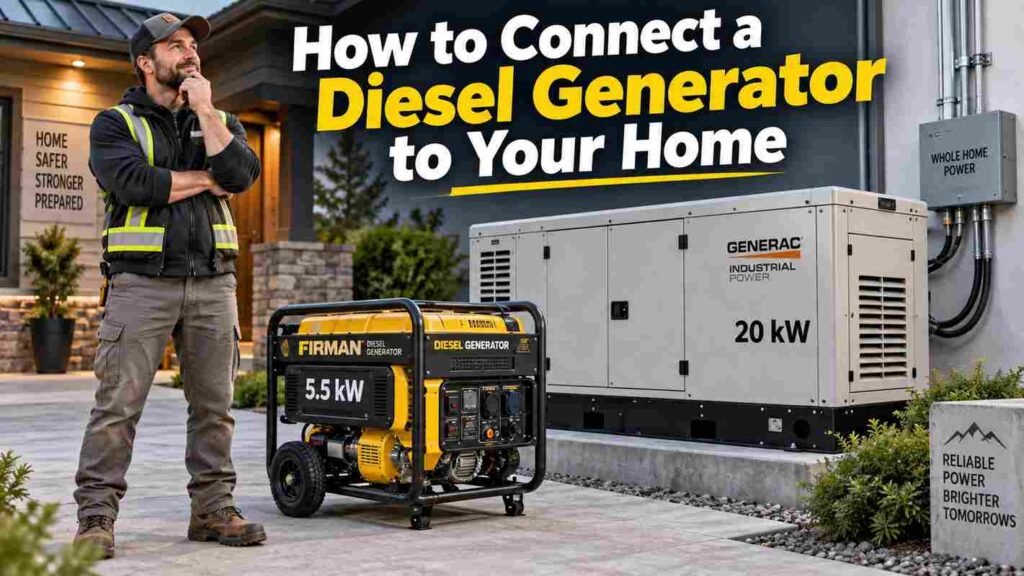
If you want to know how to connect a diesel generator to your home, I would start with the electrical system rather than the generator itself. The generator is only one part of the backup-power setup. You also need the right transfer equipment, properly sized conductors and overcurrent protection, a safe outdoor location, correct grounding and bonding, and a realistic plan for the circuits you want to power.
I also separate portable and standby systems because the connection method is different. A portable diesel generator may be rolled into position during an outage and connected to an exterior inlet. A standby diesel generator is permanently installed, usually with an automatic transfer switch that changes the home from utility power to generator power when the grid fails.
In this guide, I’ll explain the safe connection methods, what an electrician needs to check, how I size the generator and transfer equipment, and what I avoid. I’ll give you enough detail to understand the system and make good decisions, but I do not recommend DIY work inside a service panel or transfer switch unless you are qualified and permitted to do that work.



How to Connect a Diesel Generator to Your Home: The Three Main Methods
| Connection method | Best for | How power reaches the home | Automatic? | My view |
|---|---|---|---|---|
| Manual transfer switch + inlet | Portable diesel generator | Generator connects to outdoor inlet; switch selects utility or generator | No | Simple, safe, and common when properly installed |
| Listed panel interlock + inlet | Portable generator where allowed | Mechanical interlock prevents utility main and generator breaker from being on together | No | Good option when the exact panel has an approved interlock and local code allows it |
| Automatic transfer switch (ATS) | Permanent standby diesel generator | ATS detects utility loss, starts generator, and transfers the selected load | Yes | Best choice when automatic backup is important |
The key principle is isolation. The utility source and generator source must not be connected to the home at the same time unless the equipment is specifically engineered for that purpose. A transfer switch does this by selecting one source and disconnecting the other.
The Electrical Safety Foundation International says transfer switches are the safe way to power a home electrical system with a generator because they prevent dangerous backfeeding. OSHA gives the same warning: never attach a generator directly to a building electrical system unless a qualified electrician has installed a transfer switch.
Why I Never Backfeed a House Through a Dryer Outlet
Backfeeding means sending generator power into the home through a receptacle or other improvised connection instead of using approved transfer equipment. I avoid it completely.
The problem is not just whether the generator can physically energize your circuits. If the home is not properly isolated from the utility, generator power can travel backward through the service equipment and onto utility lines. That can endanger lineworkers who believe the line is de-energized.
Backfeeding can also create incorrect overcurrent protection, exposed energized male plug pins, improper neutral and grounding paths, and damage when utility power returns.
Option 1: Manual Transfer Switch for a Portable Diesel Generator
A manual transfer switch is one of the cleanest ways to connect a portable diesel generator to a house. The electrician installs a transfer switch or transfer panel and an exterior generator inlet. During an outage, I move the generator outdoors to its safe operating location, connect it to the inlet with the correct generator cord, start it, and then use the transfer equipment to move selected circuits from utility to generator power.
The transfer switch mechanically or electrically prevents the utility and generator sources from feeding the same circuits at the same time.
I like this setup for homes where I only need essential loads such as the refrigerator, freezer, well pump, furnace blower, sump pump, lights, internet equipment, and a few receptacles.
Typical portable-generator connection path
| Component | Purpose |
|---|---|
| Portable diesel generator | Produces backup power |
| Generator output receptacle | Provides the rated 120/240V output connection |
| Generator cord | Carries power from generator to the home inlet |
| Outdoor inlet box | Provides a weather-appropriate connection point on the house |
| Transfer switch or transfer panel | Isolates utility power and selects generator power |
| Branch circuits | Carry generator power to selected home loads |
I have the electrician size every part of that chain for the generator output and the panel configuration. I do not assume a 30-amp inlet is acceptable for a generator simply because the plug fits.
Option 2: A Listed Interlock Kit
A listed interlock system can be a practical alternative to a separate transfer panel on some homes. The interlock is designed for a specific electrical panel and physically prevents the utility main breaker and the generator breaker from being turned on at the same time.
I only use an interlock that is listed or approved for the exact panel model and accepted by the local authority having jurisdiction. I do not use homemade plates or generic mechanical parts.
An interlock can let me choose which house circuits I run by switching individual breakers on or off. That flexibility is useful, but it also means I have to manage the load carefully. If I turn on too many large circuits, I can overload the generator.
Option 3: Automatic Transfer Switch for a Standby Diesel Generator
If I want the home to regain power automatically, I use a permanent standby generator with an automatic transfer switch. This is the most convenient arrangement and the one I prefer for homes where backup power is critical.
A typical automatic system works like this: utility voltage is monitored, the controller detects an outage, the generator starts and stabilizes, and the ATS transfers the home or selected circuits to generator power. When utility power returns and remains stable, the ATS transfers the load back and the generator goes through its shutdown sequence.
Generac describes automatic transfer switches as equipment that transfers electrical load from the normal utility source to the standby generator and prevents electrical feedback between the two sources. I treat that isolation function as the heart of a safe standby installation.
Whole-House Transfer vs. Essential-Circuit Transfer
I do not automatically connect every circuit just because the generator can be connected to the main panel. I decide first whether the generator is meant to power the whole house or only essential loads.


| Approach | What gets generator power | Main advantage | Main limitation |
|---|---|---|---|
| Essential-circuit transfer | Selected circuits only | Smaller generator may work | You must choose priorities in advance |
| Whole-panel transfer with load management | Most or all panel circuits, with some controlled | More convenient | Needs careful load control |
| Full whole-house capacity | Nearly all normal loads at once | Feels closest to utility power | Larger generator, transfer switch, fuel use, and cost |
For many homes, essential-circuit backup gives the best value. I would rather have a correctly sized 10 or 15 kW generator reliably run the loads that matter than buy a much larger unit that spends most of its life lightly loaded.
If you are still selecting capacity, see my diesel generator sizing guide and my article on how much power a 20 kW diesel generator provides.
How Much Power Can the Generator Feed Into the House?
For a 120/240V single-phase home system, I can estimate current from watts divided by voltage. The real installation still has to account for generator rating, breaker size, receptacle rating, conductor ampacity, neutral arrangement, and manufacturer limits.
| Generator rating | Approx. current at 240V single-phase | Typical use |
|---|---|---|
| 5 kW | 20.8 A | Selected essentials |
| 7.5 kW | 31.3 A | Essentials plus a few larger loads |
| 10 kW | 41.7 A | Broader essential-circuit backup |
| 15 kW | 62.5 A | Larger home backup with load management |
| 20 kW | 83.3 A | Substantial home load or whole-house applications |
| 30 kW | 125 A | Larger homes and heavier electrical loads |
Those figures are simple power calculations, not breaker-sizing instructions. I do not size a transfer switch, conductors, or overcurrent device from this table alone. A qualified electrician uses the generator nameplate, installation manual, local code, conductor conditions, and the actual equipment ratings.
Do I Need a 200-Amp Generator for a 200-Amp House?
No. A 200-amp utility service does not mean the house continuously uses 200 amps. It means the service equipment is rated for up to that level under its design conditions.
I size the generator from the loads I actually need during an outage. A 20 kW generator at 240V is roughly 83 amps, yet it can still supply a house with a 200-amp service if the required loads fit within that generator’s capacity and the transfer system is designed correctly.
Load management can temporarily prevent large appliances such as electric water heaters, pool pumps, second air-conditioning systems, or EV chargers from operating when generator demand is high.
Typical Home Loads I Consider Before Connecting a Generator
| Load | Illustrative running demand | What I watch for |
|---|---|---|
| Refrigerator | 300–800 W | Compressor starting surge |
| Freezer | 200–700 W | Compressor starting surge |
| Well pump | 1,000–2,500+ W | High motor starting current |
| Sump pump | 800–1,500 W | Motor surge |
| Furnace blower | 400–1,000 W | Motor start |
| Microwave | 1,000–1,800 W | Short high-demand use |
| Electric water heater | 3,000–5,500 W | Large continuous resistive load while heating |
| Central A/C | Varies widely | Compressor starting requirement may dominate sizing |
These are planning examples, not appliance specifications. I use the actual nameplate and manufacturer data for each appliance, especially motors and air-conditioning equipment.
The Neutral and Grounding Question Matters
One of the reasons I leave the final electrical connection to a qualified electrician is that neutral and equipment-grounding arrangements can differ between generators and transfer equipment.
Some portable generators have the neutral bonded to the frame. Others have a floating neutral. Some transfer switches switch the neutral; others do not. The correct arrangement depends on whether the generator is treated as a separately derived system and on the transfer equipment design.
I do not “fix” this by randomly adding or removing a neutral bond. The electrician checks the generator manual, transfer-switch configuration, service bonding point, grounding electrode system, and local electrical code. An incorrect neutral-ground setup can create objectionable current on grounding paths or interfere with protective devices.
Where I Place the Diesel Generator
Connection safety is not only electrical. A diesel generator produces carbon monoxide, heat, noise, and exhaust.
For portable generators, current CDC guidance says to operate the generator outdoors at least 20 feet from doors, windows, and vents. CPSC gives the same 20-foot guidance and says to direct exhaust away from the home and other buildings.
I never operate a portable diesel generator in a garage, basement, shed, enclosed porch, or carport. Opening a garage door does not make the space safe.
I also keep the generator dry and follow the manufacturer’s wet-weather instructions. For more on that topic, see Can Diesel Generators Run in the Rain?.
How I Connect a Portable Diesel Generator During an Outage
Once a qualified electrician has installed the inlet and approved transfer equipment, the homeowner operating sequence becomes much simpler. I follow the instructions supplied with that exact transfer system and generator.
At a high level, I position the portable generator in its safe outdoor location, inspect it, connect the proper generator cord to the approved inlet, start the generator without unnecessary loads applied, let it stabilize, and then use the transfer equipment to move the selected circuits to generator power.
I bring circuits online gradually rather than switching every large load on at once. Motors and compressors can have high starting current, so staggering them reduces sudden demand.
When utility power returns, I reverse the process using the transfer-equipment instructions and allow the generator to cool down according to its manual.
What Size Generator Inlet and Transfer Switch Do I Need?
I match the inlet, cord, transfer equipment, breaker, and conductors to the generator’s rated output and connection configuration. I do not choose them independently.
| Portable connection example | Approximate maximum power at 240V | Planning note |
|---|---|---|
| 30 A | 7.2 kW | Common for smaller portable-generator connections |
| 50 A | 12.0 kW | Common for larger portable units |
| 60 A | 14.4 kW | Requires equipment specifically rated for it |
| 80 A | 19.2 kW | Usually moves into heavier permanent-style equipment |
| 100 A | 24.0 kW | Common transfer-switch class for some standby systems |
Again, these are arithmetic examples. The real equipment must be listed and rated for the application, and the generator may have an output breaker or receptacle limit lower than its engine/alternator nameplate power.
Can I Connect a 20 kW Diesel Generator to My Home?
Yes, a 20 kW diesel generator can be connected to a home when the transfer switch, conductors, overcurrent protection, grounding/bonding, voltage, and phase are all designed for that generator.
A 20 kW single-phase generator at 240V can provide roughly 83 amps of real power at unity power factor. That can support a substantial portion of a home and, in many cases, whole-house operation with load management.
The real question is whether your simultaneous running load plus the largest starting surge fits within the generator’s capability. I would not assume 20 kW is automatically enough just because the house is average-sized.
Automatic Standby Systems Need Professional Commissioning
With a permanent standby diesel generator, the installer has to do more than connect wires. I expect the installation to include correct generator placement, transfer-switch configuration, battery and charging setup, control wiring, fuel system, exhaust clearances, grounding/bonding, startup testing, and load testing.
After installation, I want the automatic sequence tested from beginning to end: simulated utility failure, generator start, voltage and frequency stabilization, transfer to generator, load operation, utility restoration, retransfer, cooldown, and return to AUTO mode.
Generac’s transfer-switch documentation includes this type of functional testing because a standby system is only useful if the generator and transfer equipment operate together correctly.
Fuel Supply Is Part of the Connection Plan
A diesel generator can be electrically perfect and still fail as a backup system if I do not plan the fuel supply.
I calculate expected runtime from the manufacturer’s fuel-consumption data at the load I expect. For example, if a generator burns 1.5 gallons per hour at the expected load, 24 hours of operation requires about 36 gallons before adding reserve.
| Fuel burn | 12 hours | 24 hours | 48 hours |
|---|---|---|---|
| 1.0 gal/hr | 12 gal | 24 gal | 48 gal |
| 1.5 gal/hr | 18 gal | 36 gal | 72 gal |
| 2.0 gal/hr | 24 gal | 48 gal | 96 gal |
| 3.0 gal/hr | 36 gal | 72 gal | 144 gal |
Actual burn depends on generator size and load. My guide to diesel generator fuel consumption explains this in more detail.
What I Check Before the First Outage
I do not wait for a storm to find out whether the connection works. After the system is installed, I run a controlled test.
I confirm the generator starts reliably, the transfer equipment works, selected circuits are labeled, large loads are identified, CO alarms are installed, the generator cord is the correct rating, fuel is available, and everyone in the household knows which equipment they should and should not operate during generator power.
I also keep a simple load list near the panel. If the generator is limited, I note which large loads cannot run together.
Maintenance Still Matters After the Electrical Work Is Done
A connected generator is not automatically a reliable generator. Batteries discharge, diesel fuel can collect water, filters clog, coolant ages, and connectors can corrode.
I follow the manufacturer’s exercise and maintenance schedule and periodically test the transfer system. My guides to diesel generator maintenance and diesel generator service intervals cover those tasks in detail.
Common Mistakes I Avoid
- Backfeeding through a receptacle. I use transfer equipment instead.
- Assuming the main breaker alone makes backfeeding safe. I use a listed transfer or interlock system designed to prevent simultaneous connection.
- Running a portable generator in a garage. I keep it outside at least 20 feet from the home, following current CDC/CPSC guidance.
- Using undersized cords or inlets. I match every component to the system rating.
- Ignoring starting surge. Motors and compressors can overload a generator that appears large enough on running watts.
- Guessing about neutral bonding. I have the electrician verify the generator and transfer-switch configuration.
- Connecting every load automatically. I prioritize critical circuits or use proper load management.
- Skipping testing. I test before I actually need the generator.
How Much Does It Cost to Connect a Diesel Generator to a House?
I do not give one universal price because the cost depends heavily on the home and the type of system. A simple portable-generator inlet and manual transfer setup is very different from a whole-house diesel standby installation with an automatic transfer switch and a large fuel tank.
| Cost factor | Why it changes the project |
|---|---|
| Generator size | Larger output may require larger transfer equipment and conductors |
| Manual vs. automatic transfer | ATS systems add controls and installation complexity |
| Distance from generator to service equipment | Longer conductor runs increase material and labor |
| Panel/service configuration | Older or crowded panels may require additional work |
| Essential circuits vs. whole house | Whole-house systems usually need larger equipment |
| Fuel tank and fuel piping | Permanent diesel systems need a compliant fuel-storage arrangement |
| Permits and inspection | Requirements vary by jurisdiction |
If I only need temporary backup for a short period, I may also consider renting. See my guide to renting a diesel generator instead of buying.
Frequently Asked Questions
Can I plug a diesel generator directly into my house?
Not into a normal wall outlet. If I want to power household wiring, I use a professionally installed transfer switch or approved interlock and generator inlet. Otherwise, I power individual appliances directly from the generator using properly rated cords where the manufacturer allows it.
Do I need a transfer switch for a diesel generator?
If the generator will energize the home’s installed wiring, I use transfer equipment. OSHA and ESFI warn against direct connection without a transfer switch because of backfeeding risk.
Can I use a 50-amp inlet with any diesel generator?
No. The generator receptacle, breaker, inlet, cord, transfer equipment, and conductors all need compatible ratings and configurations. I do not increase available power simply by installing a larger inlet.
Can a portable diesel generator run my central air conditioner?
Possibly, but I verify the compressor’s running and starting requirements. Central air can be one of the largest starting loads in a home, so I may use soft-start equipment or load management where appropriate and approved.
Can I leave a portable generator connected when utility power returns?
The generator can remain physically connected to an approved inlet if the transfer equipment is designed for that arrangement, but the operating procedure must follow the transfer-switch and generator instructions. I never allow utility and generator sources to be connected together unintentionally.
Can I install the transfer switch myself?
I recommend a qualified electrician. Transfer equipment interfaces directly with the home’s service and distribution system, and mistakes can cause shock, fire, equipment damage, or backfeed onto utility lines.
My Bottom Line
If I am connecting a diesel generator to a home, I focus on one principle first: the generator and utility must be safely isolated from each other. That means a manual transfer switch, a listed interlock arrangement where permitted, or an automatic transfer switch for a permanent standby system.
I then size the system around the loads I actually need, account for starting surge, verify voltage and phase, let a qualified electrician handle panel work and grounding/bonding details, and operate the generator outdoors in a safe location.
The physical connection is only part of the project. I also plan fuel, maintenance, load management, weather protection, and a clear operating procedure. When those pieces are designed together, a diesel generator can provide reliable home backup power without creating unnecessary electrical or carbon-monoxide hazards.
Sources and Technical References
I used current safety and manufacturer guidance while preparing this article, including OSHA portable generator safety guidance, Electrical Safety Foundation International generator safety guidance, CDC generator safety guidance, CPSC generator safety guidance, and current Generac transfer-switch documentation.