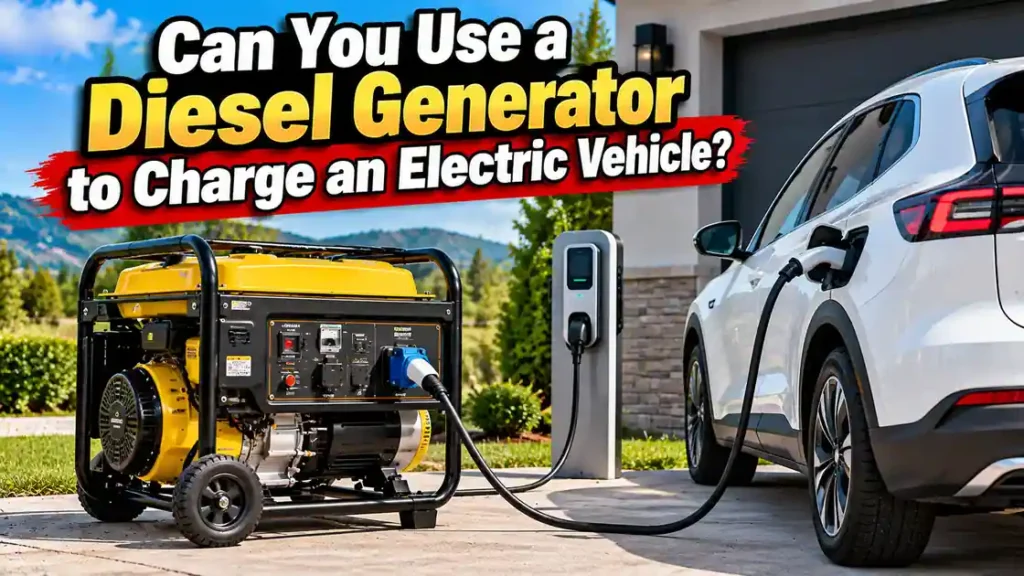


If you are asking, can you use a diesel generator to charge an electric vehicle?, the answer is yes—but there is more to it than plugging a charging cable into any generator outlet. I want you to think about the complete electrical chain: generator output, voltage and frequency stability, continuous kW capacity, receptacle type, grounding and bonding, the EVSE, and the vehicle’s onboard charger.
I also want to separate what is technically possible from what makes economic sense. A diesel generator can be extremely useful when grid power is unavailable, during an extended outage, at a remote property, at a work site, or when you simply need enough charge to reach a public charger. But if utility power is available, generator charging is usually more expensive per kWh because you are converting diesel fuel into mechanical energy, then electricity, then storing that electricity in the vehicle battery.
In this guide, I will show you how I size a diesel generator for EV charging, what Level 1 and Level 2 charging require, how long charging may take, how fuel consumption affects cost, what power-quality issues can stop charging, and when I would call an electrician or generator technician instead of experimenting.
Can a Diesel Generator Really Charge an EV?
Yes. From the EV’s point of view, the important question is not whether the electricity came from the utility grid, a diesel generator, solar, or a battery system. The vehicle’s onboard charger needs acceptable AC power from compatible EV supply equipment, commonly called EVSE.
The generator therefore has to behave like a suitable electrical source. It must maintain the correct voltage and frequency while the EV is drawing power continuously. It also needs enough capacity to run the charger without being overloaded. Some charging equipment additionally checks grounding or other electrical conditions before it allows current to flow.


If the generator voltage sags badly, frequency moves outside the charger’s acceptable window, a protection device trips, or the EVSE detects a grounding problem, the vehicle may refuse to charge or may repeatedly start and stop.
EV Charging Levels and What They Mean for Generator Size
For most owners, I focus on AC Level 1 and Level 2 charging. The U.S. Department of Energy’s Alternative Fuels Data Center describes Level 1 as 120-volt AC charging and Level 2 as 208- or 240-volt AC charging. DC fast charging is a completely different class of equipment and is not something I would try to reproduce with a normal portable or standby diesel generator.
| Charging type | Typical supply | Example charging power | Generator implication |
|---|---|---|---|
| Level 1 | 120 V AC | About 1.4-1.9 kW | A small generator may handle it if the outlet, grounding, voltage and continuous rating are suitable. |
| Level 2 | 208 or 240 V AC | Often about 3.8-11.5 kW in residential/mobile setups | Usually requires a larger generator with a proper 240 V output and adequate continuous capacity. |
| High-power Level 2 | 208 or 240 V AC | Up to 19.2 kW under common standards | Requires a substantially larger generator and professionally planned electrical connection. |
| DC fast charging | High-voltage DC | Common public systems can be 50 kW to 350+ kW | Not a normal portable-generator application; requires specialized charging equipment and major power infrastructure. |
The numbers above are planning examples, not a promise that your specific car will accept that charging rate. The EV’s onboard charger can limit AC charging power even if the generator and EVSE can provide more.
How I Calculate the Generator Size for EV Charging
I start with the charging current and voltage. For a simple single-phase AC load, the basic power calculation is:
Power in watts = volts × amps
Then I convert watts to kilowatts by dividing by 1,000.
| EVSE setting | Voltage | Charging current | Approx. electrical load |
|---|---|---|---|
| Level 1 low setting | 120 V | 12 A | 1.44 kW |
| Level 1 higher setting | 120 V | 16 A | 1.92 kW |
| Level 2 | 240 V | 16 A | 3.84 kW |
| Level 2 | 240 V | 24 A | 5.76 kW |
| Level 2 | 240 V | 32 A | 7.68 kW |
| Level 2 | 240 V | 40 A | 9.60 kW |
| Level 2 | 240 V | 48 A | 11.52 kW |
I would not buy a generator whose nameplate output only barely matches the EV charging load. EV charging is a sustained electrical demand, and the generator may also need to power its own auxiliaries or other site loads. I prefer useful headroom rather than asking the set to sit at its absolute limit for hours.
| Desired EV charging load | Minimum arithmetic load | Practical generator class I would investigate | Why |
|---|---|---|---|
| 1.4-1.9 kW Level 1 | About 2 kW | Roughly 3-5 kW continuous-capable unit | Allows headroom for voltage stability and avoids running at the edge of rating. |
| 3.8 kW Level 2 | 3.84 kW | About 5-7 kW or larger | Provides margin and allows for real generator performance. |
| 5.8 kW Level 2 | 5.76 kW | About 7-10 kW or larger | More comfortable continuous loading. |
| 7.7 kW Level 2 | 7.68 kW | About 10-12 kW or larger | Leaves room for continuous operation and small auxiliary loads. |
| 9.6 kW Level 2 | 9.60 kW | About 12-15 kW or larger | Better suited to sustained 40 A charging. |
| 11.5 kW Level 2 | 11.52 kW | About 15-20 kW or larger | Provides practical headroom for sustained charging. |
Continuous Rating Matters More Than the Big Number on the Advertisement
When I compare generators for EV charging, I look at the continuous or prime capability that applies to the way the generator will actually be used. A short-duration peak figure is not the number I want to rely on for a load that may run for several hours.
For example, if an EV is charging at 7.68 kW for four hours, that is a steady load—not a momentary motor-starting surge. The generator’s cooling system, alternator, voltage regulator and engine all have to support that output continuously.
If you are still working out generator sizing in general, see my diesel generator sizing guide.


How Long Will It Take to Charge an EV From a Diesel Generator?
I calculate a rough charging time by dividing the energy I want to add to the battery by the actual charging power. Then I allow for charging losses and the fact that an EV may reduce charging power under some conditions.
Ideal charging time = battery energy to add ÷ charging power
Suppose I want to add 30 kWh to the battery.
| Charging power | Ideal time to add 10 kWh | Ideal time to add 30 kWh | Ideal time to add 50 kWh |
|---|---|---|---|
| 1.44 kW | 6.9 hr | 20.8 hr | 34.7 hr |
| 1.92 kW | 5.2 hr | 15.6 hr | 26.0 hr |
| 3.84 kW | 2.6 hr | 7.8 hr | 13.0 hr |
| 5.76 kW | 1.7 hr | 5.2 hr | 8.7 hr |
| 7.68 kW | 1.3 hr | 3.9 hr | 6.5 hr |
| 9.60 kW | 1.0 hr | 3.1 hr | 5.2 hr |
| 11.52 kW | 0.9 hr | 2.6 hr | 4.3 hr |
These are ideal arithmetic values. Actual time will be longer because electricity is lost in the EVSE, wiring, onboard charger, battery conditioning and the battery itself. Vehicle charging logic can also reduce power.
How Much Range Can Generator Charging Add?
Range varies dramatically by vehicle efficiency, weather, speed, tires, terrain and cabin heating or air conditioning. That is why I prefer to think in kWh rather than miles. Still, for emergency planning, a simple example helps.
If an EV averages 3 miles per kWh, then adding 10 kWh could theoretically add about 30 miles of driving energy. At 4 miles per kWh, the same 10 kWh represents about 40 miles.
| Energy added | At 2.5 mi/kWh | At 3.0 mi/kWh | At 4.0 mi/kWh |
|---|---|---|---|
| 5 kWh | 12.5 miles | 15 miles | 20 miles |
| 10 kWh | 25 miles | 30 miles | 40 miles |
| 20 kWh | 50 miles | 60 miles | 80 miles |
| 30 kWh | 75 miles | 90 miles | 120 miles |
I would treat that table only as energy math. The car’s displayed range can be very different in real conditions.
Why a Generator Can Be Running Normally but the EV Still Refuses to Charge
This is one of the most confusing situations. You start the diesel generator, other tools seem to work, the voltage looks reasonable, yet the EVSE reports a fault.
There are several possible reasons.
1. Grounding or neutral-bonding compatibility
Many EVSEs perform safety checks before energizing the charging connector. A portable generator may have a bonded neutral, a floating neutral, or a configuration that depends on how the generator is intended to be connected. If the EVSE does not see the electrical condition it expects, it may refuse to charge.
I do not recommend defeating that protection with homemade neutral-ground plugs, modified adapters or improvised bonding. The correct solution is to follow the generator manual, EVSE instructions and applicable electrical rules. If the setup is not straightforward, I would have an electrician determine the correct bonding and grounding arrangement.
2. Voltage sag
A generator can show normal voltage with no load and then drop sharply once charging begins. This may happen when the generator is undersized, the engine cannot maintain speed, the AVR is faulty, or the connection has excessive resistance.
If your generator already bogs down when a heavy load is applied, I would fix that problem before trying to use it for EV charging.
3. Frequency instability
In a conventional generator, frequency is closely related to engine speed. A 60 Hz generator that slows badly under load can produce low frequency. Sensitive electronics may reject unstable power even though an incandescent light or simple power tool still works.
| Observation | Possible issue | What I would check |
|---|---|---|
| EVSE faults immediately | Grounding/bonding or wiring compatibility | EVSE code, outlet configuration, generator manual, professional inspection |
| Charging starts then stops | Voltage/frequency sag, overload or thermal protection | Generator load, voltage/frequency under load, fault codes, temperature |
| Generator labors heavily | Generator too small or engine power problem | Actual kW load, fuel/air condition, rating, derating |
| Breaker trips | Overload, fault, wrong circuit or protection event | Do not repeatedly reset; identify the cause |
| EV charges at lower power than expected | Vehicle or EVSE current limit | Vehicle charging setting, EVSE rating, supply voltage |
| Generator has no output at outlet | Breaker, AVR, excitation or alternator issue | See the no-output troubleshooting guide |
For a generator that runs but produces no useful electricity, see Diesel Generator Has No Power Output: Causes and Troubleshooting Steps.
Do You Need an Inverter Generator to Charge an EV?
No. A diesel generator does not have to be an inverter generator simply because you are charging an EV. Many commercial and standby diesel generator sets use conventional alternators with automatic voltage regulation and can provide stable AC power when correctly sized and maintained.
What matters is output quality and compatibility. I want stable voltage, stable frequency, correct wiring, correct grounding/bonding, and enough continuous capacity. An older or poorly maintained generator with erratic voltage is a much bigger concern than whether the word “inverter” appears on the label.
Can You Use Level 1 Charging From a Small Diesel Generator?
Often, yes, if the generator and EVSE are compatible. Level 1 is the easiest generator-charging scenario because the electrical demand is relatively small. A 12-amp, 120-volt charge is about 1.44 kW.
The downside is speed. If you need 20 kWh, an ideal 1.44 kW calculation is almost 14 hours before losses. That can mean many hours of generator operation for a modest amount of range.
For emergency mobility, however, slow charging can still be useful. If I only need enough battery to reach the nearest functioning public charger, I may care more about reliability than speed.
Can You Use Level 2 Charging From a Diesel Generator?
Yes, and this is where generator sizing becomes much more important. A 32-amp Level 2 load at 240 volts is 7.68 kW. A 48-amp setup is 11.52 kW. That is a major continuous load.
I would verify that the generator actually provides the required 240-volt configuration and that the EVSE connection is approved for the equipment. I would not assume that any 240-volt receptacle is automatically suitable for EV charging.
I would also consider the vehicle’s maximum AC charging rate. If the car can only accept 7.2 kW AC, buying a much larger generator just to run an 11.5 kW EVSE will not make that car charge at 11.5 kW.
What About Three-Phase Diesel Generators?
Large mobile and commercial diesel generators are often three-phase. That can be useful at an industrial or fleet site, but it does not mean I can simply connect a residential 240-volt EVSE to any available terminals.
Three-phase sets may provide 208Y/120 V, 480Y/277 V, or other configurations. Voltage, phase, neutral arrangement, overcurrent protection and grounding must all match the charging equipment. For a commercial setup, I would treat EV charging as an engineered electrical load, not an adapter problem.
How Much Diesel Fuel Will EV Charging Use?
The exact answer comes from the fuel-consumption curve for your generator at the actual load. Fuel burn is not simply proportional to nameplate kW, especially at light load.
For example, suppose a generator burns 0.8 gallon per hour while supplying an average 7.5 kW to the EVSE. If it runs for four hours, it consumes 3.2 gallons.
| Example generator fuel burn | Run time | Diesel used | Energy delivered at 7.5 kW before charging losses |
|---|---|---|---|
| 0.6 gal/hr | 4 hr | 2.4 gal | 30 kWh |
| 0.8 gal/hr | 4 hr | 3.2 gal | 30 kWh |
| 1.0 gal/hr | 4 hr | 4.0 gal | 30 kWh |
| 1.2 gal/hr | 4 hr | 4.8 gal | 30 kWh |
If fuel consumption is a major concern, use the actual manufacturer’s fuel curve or my diesel generator gallons-per-hour guide. I also explain the relationship between generator size and load in my diesel generator burn-rate guide.
How Much Does It Cost per kWh to Charge an EV With Diesel?
I calculate the fuel-only cost using:
Fuel cost per kWh = (gallons per hour × diesel price per gallon) ÷ electrical kW delivered
Suppose the generator burns 0.8 gal/hr, diesel costs $4.00 per gallon, and the generator is delivering 7.5 kW.
Hourly fuel cost = 0.8 × $4.00 = $3.20 per hour.
Fuel-only electricity cost = $3.20 ÷ 7.5 = about $0.43 per kWh before EV charging losses, maintenance, depreciation and other generator costs.
| Fuel burn | Diesel price | Electrical output | Fuel-only cost per kWh |
|---|---|---|---|
| 0.6 gal/hr | $4.00/gal | 7.5 kW | $0.32/kWh |
| 0.8 gal/hr | $4.00/gal | 7.5 kW | $0.43/kWh |
| 1.0 gal/hr | $4.00/gal | 7.5 kW | $0.53/kWh |
| 1.2 gal/hr | $4.00/gal | 7.5 kW | $0.64/kWh |
This is why I say generator charging is usually a backup strategy rather than a cheap substitute for grid charging. For a more complete calculation that includes maintenance and ownership, see my diesel generator cost-per-kWh guide.
Will Charging an EV Be Too Light a Load for a Large Diesel Generator?
It can be. Imagine using a 100 kW generator to provide a 1.4 kW Level 1 charge. The engine would be carrying only a tiny fraction of its capacity. Long periods of very low loading are generally not what large diesel generator sets are designed around, and persistent low-load operation can contribute to poor combustion and wet-stacking concerns on some engines.
If generator charging will be routine, I would size the generator around the expected charging load and other simultaneous loads rather than simply using the largest set available.
What Happens If Other Loads Are Running at the Same Time?
You have to add them. The generator does not care whether the electricity goes to an EV, an air conditioner, lights, a pump, or a refrigerator. It sees total load.
| Load | Example demand |
|---|---|
| EV charging | 7.68 kW |
| Building lights | 1.0 kW |
| Refrigeration | 1.5 kW running, potentially higher during starting |
| Small HVAC load | 3.0 kW running |
| Total running demand | 13.18 kW |
I would also account for motor starting and load steps. EV charging itself is generally a controlled electronic load, but a pump or compressor starting while the car is already charging can cause a sharp voltage dip if the generator has little reserve capacity.
Can Generator Power Damage an EV?
A correctly functioning generator used with compatible charging equipment should provide power within the requirements of the EVSE and vehicle. The bigger risk comes from unsuitable or faulty equipment: unstable voltage, incorrect frequency, improper wiring, bad grounding, damaged receptacles, unsafe adapters, overloads or a generator with a failing voltage regulator.
I would not use an EV as the test instrument for a generator that I already suspect has electrical problems. If output is questionable, I would have the generator tested under load first.
Why I Avoid Improvised Adapters and Extension Cords
EV charging can draw a high current continuously for hours. That makes connection quality important. A loose plug, undersized cord, worn receptacle or poorly made adapter can heat up under sustained load.
Some vehicle manufacturers specifically warn against using extension cords, power strips or improvised conversion devices with their portable charging equipment. I follow the charging-equipment manufacturer’s instructions instead of assuming an adapter is safe because the plugs physically fit.
I also never recommend backfeeding a house panel from a generator to reach an EV charger. If a building’s hardwired EVSE is to be powered during an outage, the generator connection needs approved transfer equipment and an electrical design that isolates utility power correctly.
Portable Generator Safety Still Applies
Charging an EV does not change generator exhaust hazards. A diesel generator must never be operated inside a garage, house, basement or other enclosed space. I position portable equipment outdoors according to the generator manufacturer’s safety instructions, with exhaust directed away from occupied spaces and openings.
I also protect the generator and electrical connections from weather as required by the equipment design. I do not improvise a tightly enclosed box around a generator because that can create cooling and exhaust problems.
When Does Charging an EV With a Diesel Generator Make Sense?
I see several situations where it can be reasonable.
- Extended grid outage: You already operate a properly installed backup generator and want to restore some vehicle mobility.
- Remote work site: A diesel generator is the site’s primary electrical source and an EV or plug-in vehicle needs charging.
- Emergency roadside or recovery support: You need enough energy to move the vehicle to a charger rather than fully recharge it.
- Off-grid property: A generator supplements solar and batteries during poor weather or unusually high demand.
- Fleet resilience: A business wants a contingency source for limited EV charging during utility interruptions.
For routine daily charging where the grid is available, I would normally compare grid electricity, solar and battery storage before choosing diesel generation.
Diesel Generator vs. Battery Backup for EV Charging
A battery system can charge an EV without engine noise, exhaust or fuel handling, but its stored energy is finite. A diesel generator can continue producing electricity as long as it has fuel and remains within its operating and maintenance limits.
| Factor | Diesel generator | Battery backup |
|---|---|---|
| Energy source | Stored diesel fuel | Stored electrical energy |
| Refill/recharge | Refuel tank | Recharge from grid, solar or generator |
| Noise | Engine and exhaust noise | Very low |
| Local exhaust emissions | Yes | No during discharge |
| Long outage endurance | Potentially strong if fuel supply is available | Limited by battery capacity unless renewable generation is available |
| Maintenance | Engine, fuel, oil, filters, cooling and starting system | Generally less mechanical maintenance |
I compare these systems in more detail in Diesel Generator vs. Battery Backup.
A Practical Example: Charging a 75 kWh EV During an Outage
Assume the battery is at 20% and I only want to bring it to 60%. That means I want to add roughly 40% of 75 kWh, or 30 kWh of battery energy.
If the car is charging at 7.68 kW, the ideal arithmetic time is:
30 kWh ÷ 7.68 kW = 3.9 hours.
Actual generator run time will be longer because charging is not 100% efficient and the vehicle may not maintain exactly 7.68 kW throughout the session.
If the generator burns 0.8 gal/hr at that operating point and runs 4.5 hours, fuel consumption would be approximately:
0.8 × 4.5 = 3.6 gallons.
| Example item | Value |
|---|---|
| EV battery capacity | 75 kWh |
| Starting state of charge | 20% |
| Target state of charge | 60% |
| Approx. battery energy to add | 30 kWh |
| AC charging power | 7.68 kW |
| Ideal arithmetic charging time | 3.9 hr |
| Illustrative real session allowance | About 4.5 hr |
| Example generator burn rate | 0.8 gal/hr |
| Example diesel used | About 3.6 gal |
The 4.5-hour and fuel figures are only an illustration. I would use the actual car, EVSE and generator data when planning a real installation.
My Checklist Before I Charge an EV From a Diesel Generator
- I confirm the generator’s voltage, frequency and continuous kW rating.
- I confirm the output configuration and approved receptacle.
- I verify the EVSE’s voltage and current requirements.
- I make sure the car’s maximum AC charging rate is known.
- I account for every other load running on the generator.
- I check generator fuel, oil, coolant and ventilation before a long charging session.
- I use only approved plugs, cords and adapters specified by the equipment manufacturers.
- I do not defeat grounding, GFCI/RCD or EVSE protection.
- I monitor voltage/frequency, generator temperature and fault indications during initial operation.
- I stop if the generator hunts, overloads, trips repeatedly, overheats or produces unstable output.
Frequently Asked Questions
Can a 5 kW diesel generator charge an electric car?
Potentially, yes. It may be suitable for Level 1 and some lower-current Level 2 charging, depending on the generator’s continuous rating, voltage configuration, power quality and EVSE requirements. I would not assume a 5 kW nameplate automatically means every 5 kW charging setup is acceptable.
Can a 10 kW diesel generator charge an EV?
Often, yes. A true 10 kW continuous-capable 240 V generator may be able to support common Level 2 charging rates such as 16, 24 or 32 amps, provided the electrical configuration and charging equipment are compatible. Other loads must be included in the calculation.
How many kW do I need to charge an EV?
That depends on the charging rate you want. Level 1 is commonly around 1.4-1.9 kW. Common residential Level 2 examples include 3.84, 5.76, 7.68, 9.6 and 11.52 kW. I size the generator above the actual sustained charging demand rather than matching it exactly.
Will an EV charge from a portable generator?
Some EV and portable-EVSE combinations will, but not every combination is compatible. Grounding/bonding checks, receptacle configuration, voltage stability and generator capacity can all affect whether charging starts.
Can I plug the EV charger directly into the generator?
Only when the generator provides an approved, compatible supply for that specific EVSE and the manufacturer’s instructions allow it. I would not improvise adapters or change grounding just to make the charger accept the generator.
Why does my EV charger say ground fault when connected to a generator?
The charging equipment may be detecting a grounding or neutral configuration that it considers unsafe. Portable generator bonding arrangements vary. I would check both manuals and have an electrician evaluate the setup rather than bypassing the safety check.
Is charging an EV with a diesel generator efficient?
It works, but it usually is not the lowest-cost or most energy-efficient routine charging method because diesel is converted to mechanical energy, then AC electricity, then DC energy stored in the battery. It makes the most sense to me as backup, remote or emergency charging.
Can I charge an EV while the generator also powers my house?
Yes, if the generator and transfer system are properly designed for the combined load. I add the EV charging demand to the building’s running and starting loads and make sure the generator remains within its applicable rating.
Can I use DC fast charging from a diesel generator?
Technically, commercial mobile generation can supply DC fast-charging equipment, and temporary charging systems exist for fleets and events. But that is a specialized high-power system, not something I would build around a normal portable generator. It requires compatible power electronics, electrical protection and professional engineering.
Bottom Line
You can use a diesel generator to charge an electric vehicle, and in the right situation it can be an extremely useful backup option. The key is to treat EV charging as a serious continuous electrical load rather than just another appliance.
I start by identifying the EVSE voltage and current, calculate the real kW demand, choose a generator with adequate continuous capacity, verify the output configuration and grounding requirements, and make sure the vehicle and charger accept the generator’s power. I also consider fuel use and charging time before deciding whether the setup makes practical sense.
For a small emergency top-up, Level 1 may be enough. For meaningful overnight or outage charging, Level 2 can be much more practical—but it demands a larger and properly configured generator. If the generator will be tied into a building, hardwired EVSE or transfer system, I would involve a qualified electrician rather than improvising the connection.
External references: U.S. Department of Energy Alternative Fuels Data Center, Electric Vehicles for Consumers; Alternative Fuels Data Center, Electric Vehicle Charging Stations; Tesla, Mobile Connector Owner’s Manual.