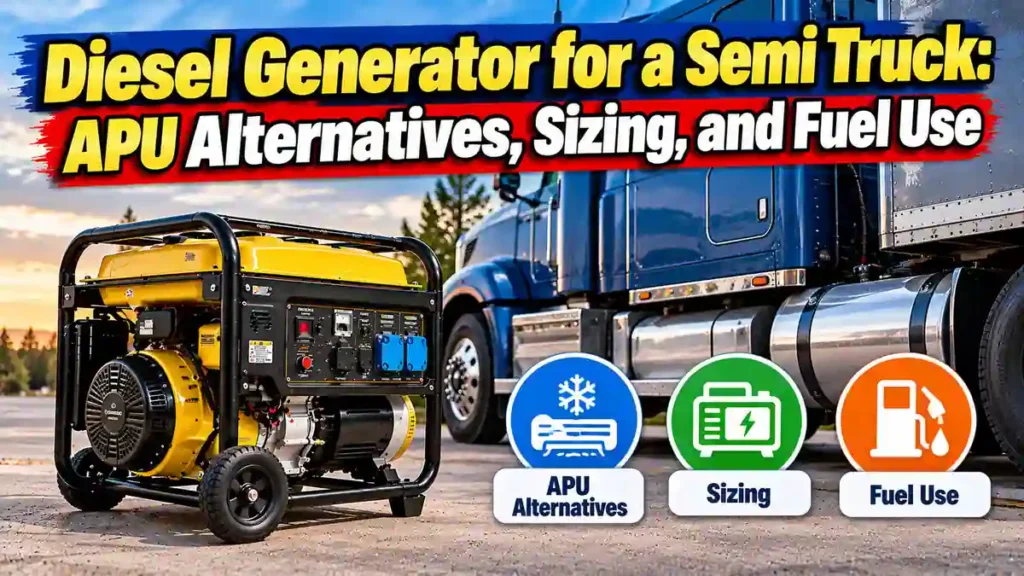


Quick answer: If I only need hotel-load electricity in a semi truck, I usually look at roughly a 2–3 kW generator for light loads and 3–5 kW for heavier sleeper loads. A full truck APU is often the better solution because it can combine cab cooling, heating, battery charging, and electrical power in one package. A typical long-haul tractor can burn about 0.8 gallon of diesel per hour while idling, while EPA material has used about 0.2 gallon per hour as a typical APU fuel-use figure. Actual fuel use depends on the APU, climate, electrical load, and how often the unit cycles.
If you are thinking about using a diesel generator for a semi truck, the first thing I want you to decide is what problem you are actually trying to solve. Do you only want 120-volt power for a microwave, TV, laptop, refrigerator, CPAP machine, and battery charger? Do you also want air conditioning through the night? Do you need heat in winter? Do you want the unit to keep the tractor batteries charged and help warm the engine coolant?
Those questions matter because a small diesel generator and a true truck auxiliary power unit are not the same thing. A generator primarily makes electricity. A diesel APU is usually an integrated truck system designed around sleeper comfort, charging, climate control, and reduced main-engine idling. In many trucks, a purpose-built APU is a cleaner solution. However, a compact generator can still make sense for specific power-only applications when it is sized and installed correctly.
In this guide, I will show you how I size a generator for semi-truck hotel loads, how much fuel you can expect to use, how the numbers compare with idling the tractor, and when battery APUs, shore power, or diesel APUs make more sense.
Diesel Generator for a Semi Truck: Technical Overview
| Item | Typical planning range or consideration | What I look for |
|---|---|---|
| Generator output | About 2–5 kW for many sleeper power-only setups | Enough continuous watts plus surge headroom |
| Full-featured diesel APU electrical output | Often several kW; some truck APUs are around 6 kW | Climate control, hotel loads, battery support |
| Main-engine idling fuel use | About 0.8 gal/hr in EPA long-haul examples | Baseline for comparing idle-reduction options |
| Small diesel APU fuel use | EPA planning example around 0.2 gal/hr | Actual rate varies with load, cycling, and model |
| Current manufacturer comparison | Thermo King says its TriPac APU uses about 75% less fuel per hour than tractor idling | Useful directionally; individual results vary |
| Electric APU cooling | Carrier examples: 7,500 BTU/hr | Cooling capability without running a small diesel engine |
| Electric APU runtime | Carrier AGM example up to 11 hours; lithium-ion example up to 17 hours | Depends heavily on ambient conditions and duty cycle |
| Shore power | Commonly 110/120 VAC on truck APU systems | Lowest-idle option when parking has compatible power |
I treat every number in this table as a planning figure, not a promise. Truck loads vary, sleeper insulation varies, ambient temperature matters, and different APUs manage their engine and compressor differently.


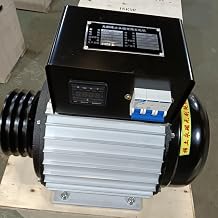
Why Use a Generator Instead of Idling the Truck?
The main reason is simple: using a 12- or 15-liter tractor engine just to run sleeper loads is inefficient. EPA SmartWay material has long used roughly 0.8 gallon per hour as a typical long-haul truck idling figure. That means eight hours of overnight idling can consume about 6.4 gallons.
| Idle time | At 0.8 gal/hr | Diesel used |
|---|---|---|
| 5 hours | 5 × 0.8 | 4.0 gallons |
| 8 hours | 8 × 0.8 | 6.4 gallons |
| 10 hours | 10 × 0.8 | 8.0 gallons |
| 2,000 idle hours/year | 2,000 × 0.8 | 1,600 gallons/year |
That is why idle-reduction equipment exists. The U.S. EPA recognizes auxiliary power units and generator sets as idle-reduction technologies for long-haul trucks. Thermo King currently says its TriPac APU consumes approximately 75% less fuel per hour than idling the tractor engine. The exact savings depend on the truck and conditions, but the basic engineering logic is sound: a small power source matched to a small hotel load normally burns less fuel than the main propulsion engine.
If fuel consumption is the main reason you are considering a generator, I also recommend reading my guide to diesel generator burn rate and my broader explanation of how much fuel a diesel generator uses.
A Semi-Truck Generator Is Not Automatically an APU
This distinction saves a lot of confusion. A normal diesel generator converts engine power into electricity. A truck APU can do much more. Depending on the system, it may provide air conditioning, a fuel-fired heater, 12-volt battery charging, 120-volt inverter power, engine-coolant warming, and automated start-stop control.
Thermo King’s TriPac Evolution, for example, is designed around sleeper climate control, truck battery charging, and cold-weather support. Carrier’s electric APU systems combine cooling, battery storage, optional heating, shore power, and inverter capability. A basic generator does none of that automatically.
So when you ask me, “What size generator do I need for my semi?” I first separate electrical loads from climate-control loads. If you want to run a rooftop or window-style electric air conditioner, the generator must carry that electrical load and its starting surge. If the APU drives its air-conditioning compressor mechanically or uses a dedicated electric HVAC system, generator sizing works differently.
What Size Diesel Generator Do I Need for a Semi Truck?
For many sleeper trucks, I see power needs falling into three practical bands. I do not size by guessing from the number of appliances. I add the watts that can operate at the same time, identify the highest starting surge, and leave margin.
| Generator size | Best suited for | Typical limitation |
|---|---|---|
| 1.5–2 kW | Laptop, TV, CPAP, lights, refrigerator, chargers | Limited headroom for microwave, coffee maker, or electric A/C |
| 2–3 kW | Normal sleeper hotel loads, microwave used selectively, inverter/charger | Large resistive loads must be managed |
| 3–5 kW | Heavier hotel loads and some electric cooling setups | Weight, space, noise, heat rejection, and fuel use rise |
| 5–6+ kW | High hotel-load demand or full-featured APU/genset territory | Installation complexity becomes more important |
If you only charge phones, run a laptop, keep a refrigerator cold, and use a CPAP machine, a large generator is unnecessary. If you expect to run a 1,500-watt microwave, 1,000-watt coffee maker, refrigerator, chargers, and an electric air conditioner at the same time, the load can climb quickly.
Typical Sleeper-Cab Electrical Loads
| Load | Illustrative running watts | Possible startup issue? |
|---|---|---|
| Laptop charger | 50–150 W | Usually minor |
| TV | 40–150 W | Usually minor |
| CPAP | 30–100 W | Usually minor |
| Compact refrigerator | 60–200 W | Yes, compressor surge |
| Microwave | 1,000–1,800 W input | High running load |
| Coffee maker | 700–1,500 W | Mostly resistive load |
| Small electric heater | 750–1,500 W | Very high continuous load |
| Sleeper A/C system | Varies widely | Compressor starting and cycling matter |
| Battery charger/inverter-charger | Varies | Can draw substantial current when batteries are low |
These are planning numbers, not nameplate specifications. I always use the actual wattage or amperage shown on the appliance and the inverter or charger documentation.
How I Calculate the Required Generator Size
I use a simple process. First, I list everything that may run simultaneously. Second, I add the running watts. Third, I identify motors or compressors that may start while other loads are already on. Finally, I add practical headroom instead of operating the generator at its absolute limit all night.


For a simplified example, assume a truck has these loads:
| Load | Running watts |
|---|---|
| Refrigerator | 150 W |
| TV | 100 W |
| Laptop | 100 W |
| CPAP | 60 W |
| Battery charging and miscellaneous loads | 250 W |
| Microwave | 1,500 W |
| Total while microwave is on | 2,160 W |
A 2 kW unit would be too tight in that situation. A 3 kW generator gives much more practical room. If I can guarantee the microwave and other heavy loads will never overlap, I can sometimes use a smaller system, but I prefer sizing that does not require constant attention.
Do I Need a 5 kW or 6 kW Generator?
Not necessarily. Bigger is not automatically better. Oversizing adds weight, consumes mounting space, may increase noise, and can force a small diesel engine to spend long periods at very light load. Diesel engines generally prefer meaningful loading rather than endless low-load operation.
A 5–6 kW system makes sense when you genuinely need the output, when the generator is part of a purpose-built truck APU, or when you want to support larger climate-control and hotel loads. Carrier has offered full-featured diesel APUs with around 6 kW of generator output, which shows the general scale of a system intended to supply broad sleeper electrical needs.
But a driver whose peak electrical demand is only 1.5–2 kW may be better served by a smaller generator, a battery APU, or a strong inverter/battery setup.
How Much Fuel Does a Semi-Truck Diesel Generator Use?
Fuel use depends on engine displacement, load, ambient conditions, maintenance, and whether the unit runs continuously or cycles. For planning, EPA material has used about 0.2 gallon per hour as a typical APU fuel-use figure, compared with about 0.8 gallon per hour for a long-haul tractor idling.
That 0.2 gal/hr number should not be treated as a universal specification for every truck generator. A lightly loaded compact unit may burn less; a larger unit working hard may burn more. The correct number comes from the manufacturer fuel-consumption data or from measuring actual fuel use in your duty cycle.
| Operating time | At 0.2 gal/hr APU example | At 0.8 gal/hr tractor-idle example | Difference |
|---|---|---|---|
| 5 hours | 1.0 gal | 4.0 gal | 3.0 gal |
| 8 hours | 1.6 gal | 6.4 gal | 4.8 gal |
| 10 hours | 2.0 gal | 8.0 gal | 6.0 gal |
| 100 hours | 20 gal | 80 gal | 60 gal |
| 1,000 hours | 200 gal | 800 gal | 600 gal |
This simplified comparison is one reason APUs can pay back their purchase and installation cost on trucks with substantial overnight idle time. Thermo King’s current marketing for its TriPac APU similarly states about 75% less fuel use per hour than idling the tractor engine.
Fuel-Cost Example
Suppose diesel costs $4.00 per gallon and I need eight hours of sleeper power.
| Method | Fuel used | Fuel cost at $4/gal |
|---|---|---|
| Tractor idling at 0.8 gal/hr | 6.4 gal | $25.60 |
| APU example at 0.2 gal/hr | 1.6 gal | $6.40 |
| Illustrative difference | 4.8 gal | $19.20 per night |
Over 200 similar nights, that simple example becomes $3,840 in fuel difference. Actual economics depend on your diesel price, idle hours, APU duty cycle, service cost, depreciation, and how much main-engine maintenance is avoided.
Diesel APU vs. Standalone Diesel Generator
| Feature | Diesel APU | Standalone compact diesel generator |
|---|---|---|
| 120-V electrical power | Usually available directly or through inverter | Primary function |
| Cab air conditioning | Common integrated function | Requires separate electric A/C |
| Heating | Often fuel-fired or integrated | Separate heater required |
| Truck battery charging | Typically integrated | Requires compatible charger |
| Engine preheat | Available on some systems | Usually separate equipment |
| Automatic start/stop | Common | Depends on generator/controller |
| Installation integration | Designed for tractor use | Requires careful custom integration |
| Best use | Complete sleeper comfort and idle reduction | Power-only or specialized loads |
If I am building a long-haul sleeper solution from scratch, I usually evaluate the APU first because integration is valuable. If I have a service truck, mobile workshop, specialty tractor, or power-only requirement, a generator may be perfectly reasonable.
Electric APU as an Alternative
A battery APU eliminates the small diesel engine entirely during operation. Carrier’s current ComfortPro electric APU uses four Group 31 AGM batteries totaling 400 Ah and is marketed for up to 11 hours of runtime under appropriate conditions. Its newer lithium-ion 250ION system uses two 12.8-volt lithium-ion batteries, weighs about 347 pounds with batteries, provides 7,500 BTU/hr of air conditioning, and is marketed for up to 17 hours of continuous air conditioning under certain real-world conditions.
| APU alternative | Example characteristic | Main advantage |
|---|---|---|
| Diesel APU | Small engine, electrical power, HVAC integration | Long runtime as long as fuel is available |
| AGM battery APU | Carrier example: 400 Ah, up to 11 hours | Quiet, no engine emissions while operating |
| Lithium-ion APU | Carrier example: 347 lb, up to 17 hours | Longer runtime with lower weight than its AGM system |
| Shore power | 110/120-V source at compatible parking location | No truck or APU engine operation while connected |
| Fuel-fired heater + battery/inverter | Heating uses little electrical power | Very effective in cold climates |
The tradeoff is stored energy. A battery APU eventually needs charging from the truck alternator, regenerative strategy, shore power, or another source. Hot weather, poor sleeper insulation, and long rest periods can reduce practical runtime. Diesel APUs are less dependent on battery capacity but bring engine maintenance, fuel use, noise, and emissions.
What About a Large Inverter and Truck Batteries?
For lighter loads, a generator may be unnecessary. A high-quality pure-sine inverter can power many sleeper appliances from the truck’s DC electrical system. The key limit is battery energy.
For example, a nominal 12-volt 400 Ah battery bank contains:
12 V × 400 Ah = 4,800 Wh, or 4.8 kWh nominal
That does not mean you can use all 4.8 kWh. Battery chemistry, allowable depth of discharge, inverter efficiency, temperature, aging, and reserve requirements reduce usable energy.
| Average hotel load | Energy used in 8 hours |
|---|---|
| 200 W | 1.6 kWh |
| 400 W | 3.2 kWh |
| 600 W | 4.8 kWh |
| 1,000 W | 8.0 kWh |
This is why low-power electronics are easy for batteries while continuous electric heating or heavy A/C is much more demanding.
Shore Power Can Be the Simplest Answer
If your regular truck stops, terminals, or customer sites provide suitable shore power, I would consider it before carrying another engine. A shore-power connection can run compatible hotel loads and charge an APU battery system without burning fuel at the parking location.
Carrier lists shore-power adapters on its electric APU systems, and Thermo King also supports truck auxiliary systems designed around hotel-load power. The practical limitation is availability. Shore power is only useful where compatible infrastructure exists, so long-haul drivers still need an independent solution for other stops.
Can I Mount a Portable Diesel Generator on a Semi Truck?
I would not treat an ordinary consumer portable generator as a bolt-on APU. Truck installation involves continuous vibration, rain and road spray, exhaust management, fuel supply, heat rejection, electrical bonding, service access, and collision exposure. A setup that appears fine while parked in a driveway may not be suitable for thousands of highway miles.
Safety: Never operate a combustion generator inside the sleeper, cab, enclosed storage compartment, or any location where exhaust can enter occupied space. Carbon monoxide is odorless and can be fatal. Exhaust routing, enclosure design, fuel plumbing, electrical protection, mounting, and ventilation should follow the equipment manufacturer and applicable vehicle/electrical requirements.
I prefer equipment specifically approved for mobile or vehicle applications. For larger mobile sets, the installation principles I discuss in my portable diesel generators for construction sites guide are also useful: keep airflow unrestricted, protect cables, control exhaust exposure, and size the generator for the real load.
Annual Fuel-Savings Example
Here is an illustrative fleet-style calculation using the EPA planning values above. Assume 1,500 overnight idle-replacement hours per year.
| Method | Fuel rate | 1,500 hours | Fuel cost at $4/gal |
|---|---|---|---|
| Tractor idling | 0.8 gal/hr | 1,200 gal | $4,800 |
| APU example | 0.2 gal/hr | 300 gal | $1,200 |
| Illustrative difference | — | 900 gal | $3,600/year |
This does not include APU purchase price, maintenance, repairs, depreciation, or main-engine maintenance savings. I would never use this table as a guaranteed payback calculation. It is simply a way to understand why high-idle trucks can justify dedicated idle-reduction equipment much faster than trucks that only spend a few nights per month parked.
My Sizing Checklist for a Semi-Truck Generator
Before I choose a generator, I write down every hotel load, its actual nameplate watts or amps, how many loads can run together, and which loads have compressors or motors. I then decide whether climate control will be electric or handled by a separate APU/HVAC system.
I also check mounting space, total installed weight, exhaust route, ventilation, fuel pickup, service access, sound level, battery-charging needs, cold-weather needs, shore-power compatibility, and whether a truck-specific APU would solve the same problem more cleanly.
Finally, I compare operating hours. If the system will replace hundreds or thousands of idle hours every year, fuel economy and serviceability become major financial factors. If it will run only occasionally, a simpler battery/inverter or shore-power solution may be better.
Frequently Asked Questions
What size generator is best for a semi truck?
For power-only sleeper loads, I usually start around 2–3 kW and calculate upward from the actual appliances. Heavier electrical loads or electric climate control may push the requirement to 3–5 kW or more. A full-featured APU can provide several kilowatts plus dedicated HVAC functions.
How much fuel does a semi-truck APU use per hour?
EPA technical material has used about 0.2 gallon per hour as a typical APU value, while typical tractor idling has often been estimated around 0.8 gallon per hour. Real APU consumption varies by model, temperature, electrical load, and cycling strategy.
How much fuel does a semi burn while idling?
EPA SmartWay material has commonly used about 0.8 gallon of diesel per hour for a long-haul combination truck. Your actual truck may be higher or lower depending on engine, accessories, idle speed, and environmental conditions.
Is a diesel APU better than a generator?
For a long-haul sleeper, often yes, because the APU is designed to provide a package of cooling, heating, charging, and electrical power. A generator can be better if you only need AC electricity or have a specialized mobile-power application.
Are electric APUs good for semi trucks?
They can be excellent when quiet operation and low maintenance are priorities. Their limitation is stored battery energy. Current lithium-ion systems can deliver long overnight cooling runtime, but actual performance still depends on heat load, insulation, settings, and charging opportunities.
Can I run a portable generator next to my sleeper?
I would not use an improvised portable-generator setup near occupied space. Carbon-monoxide exposure, exhaust recirculation, fire risk, vibration, rain exposure, fuel handling, and electrical protection all need to be controlled. Vehicle-mounted power equipment should be installed for the application and operated according to its manufacturer instructions.
Bottom Line
A diesel generator for a semi truck can be a practical solution, but I would not choose one until I separate electrical power needs from HVAC and engine-support needs. For light sleeper hotel loads, roughly 2–3 kW can be enough. For heavier power demand, I may move toward 3–5 kW. Once I need serious climate control, battery management, heating, and engine preheat, a purpose-built APU usually becomes the more complete solution.
The biggest economic advantage is reducing main-engine idling. EPA material has used about 0.8 gallon per hour for typical long-haul idling and about 0.2 gallon per hour for an APU planning example, while Thermo King currently advertises approximately 75% lower hourly fuel use for its TriPac APU compared with tractor idling. That can create substantial fuel savings for a truck that spends hundreds or thousands of hours parked each year.
My final rule is simple: size from the real loads, not from the generator label you hope will work. Count watts, allow for surge, leave reasonable headroom, and then compare the complete system—fuel, weight, noise, maintenance, HVAC, charging, and installation—not just the purchase price of the generator.
Sources and Further Reading
For technical background, I referenced U.S. EPA SmartWay material on idle-reduction technologies and truck idling, Thermo King’s current TriPac APU information, and Carrier’s current ComfortPro electric and lithium-ion APU specifications.