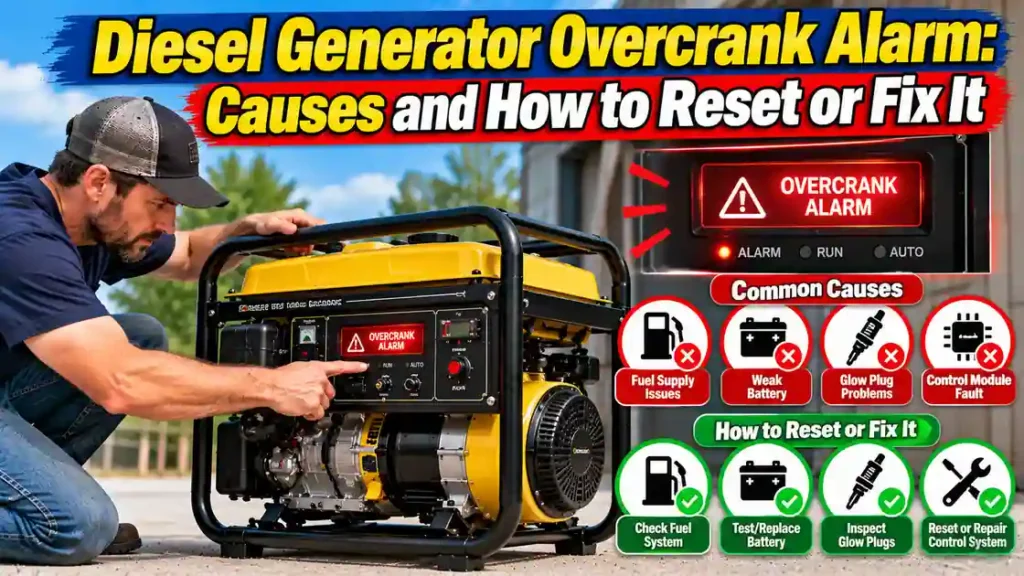


If your diesel generator shows an overcrank alarm, the engine has usually tried to start several times and failed. The controller eventually stops further cranking to protect the starter, batteries, and engine. You may hear the engine turn normally, turn slowly, fire briefly and die, or not rotate at all. Those details matter because they point me toward very different causes.
In this guide, I will show you how I approach a diesel generator overcrank alarm safely. I will explain what overcrank means, how it differs from other alarms, what numbers are useful to record, what you can inspect without bypassing safety systems, and when the problem belongs to a qualified generator technician.
What Does an Overcrank Alarm Mean on a Diesel Generator?
Most automatic generator controllers use a programmed starting sequence. When a start signal arrives, the controller energizes the starter for a limited cranking period. If the engine does not reach a successful-start threshold, the controller pauses and tries again. After the permitted number of attempts, it locks out further starts and displays an overcrank, fail-to-start, or start-failure alarm.
The exact logic varies by brand and controller. One system may judge a successful start by engine speed. Another may use oil pressure, generator frequency, alternator output, or a combination of signals. That is why I never assume one universal overcrank setting applies to every generator.
| Controller event | What it usually means | What I check first |
|---|---|---|
| Cranks normally but never fires | Fuel, air, cold-start, shutdown, or injection-related issue | Fuel level, valves, filters, air intake, fault history |
| Cranks slowly | Battery, cable, starter, temperature, or mechanical drag | Battery state, terminals, voltage drop, oil viscosity |
| Fires then dies | Fuel starvation, shutdown input, speed-signal issue, or controller logic | Stored alarms, fuel delivery, speed feedback |
| No crank at all | Start circuit, battery disconnect, E-stop, interlock, relay, or starter issue | E-stop, DC supply, start permissives, starter circuit |
| Starts locally but not automatically | ATS/start-signal/controller configuration issue | Remote-start signal, mode, ATS interface |
Overcrank Is Not the Same as Overspeed or Low Oil Pressure
I often see owners confuse overcrank with other shutdowns. Overcrank means the controller could not complete a successful start sequence. Overspeed means the engine exceeded an allowed speed after it was already running. Low oil pressure means oil pressure did not remain above the engine’s required threshold. Underspeed means the engine did not maintain the required operating speed.


If you have several alarms at once, I look at the sequence and timestamps. The first fault is often more useful than the final lockout message. For example, low battery voltage may occur before overcrank. A fuel-pressure fault may appear before the final fail-to-start. I record the codes before clearing them.
Technical Details I Record Before Troubleshooting
| Item | Typical unit | Why it matters |
|---|---|---|
| Battery system | 12 V or 24 V nominal | Determines expected cranking-system readings |
| Battery voltage before crank | V DC | Shows state of charge and possible weak battery |
| Battery voltage during crank | V DC | Shows voltage sag under starter load |
| Cranking speed | rpm | Diesels need enough speed to build compression heat and injection pressure |
| Crank duration | seconds | Controller-specific; repeated long cranking can overheat starter |
| Number of start attempts | count | Controller-specific lockout logic |
| Fuel level | % or gallons/litres | Low level or pickup exposure can introduce air |
| Ambient temperature | °F or °C | Cold weather affects batteries, oil, fuel, and starting aids |
| Coolant temperature | °F or °C | Block-heater or cold-start problems may show here |
| Fault code and timestamp | code/time | Helps identify the first event in the failure sequence |
1. Low or Discharged Starting Batteries
A weak battery is one of the first things I investigate. A battery can show what looks like acceptable open-circuit voltage and still collapse under the heavy current demanded by the starter. If cranking sounds slower than normal, the lights on the controller dim, or the starter clicks, battery condition deserves immediate attention.
Standby generators are especially vulnerable because they may sit for long periods while depending on a battery charger to maintain the starting batteries. A failed charger, loose DC connection, sulfated battery, corroded terminal, or aged battery can leave the set unable to reach proper cranking speed during an outage.
I check that the charger is powered, battery terminals are clean and tight, cable lugs are secure, and battery disconnects are fully engaged. For a deeper diagnosis, a technician can perform battery load testing and voltage-drop testing of the starter circuit.
2. Loose, Corroded, or High-Resistance Battery Cables
Sometimes the batteries are good but the starter is not receiving enough current. A corroded terminal, loose ground strap, damaged cable, or poor connection can create a voltage drop only when the starter draws high current.
I visually inspect both positive and negative cable paths, not only the battery posts. On many installations the engine ground connection is just as important as the positive feed. Heat discoloration, green corrosion, loose hardware, and frayed conductors are warning signs.
3. Fuel Tank Is Empty or the Usable Fuel Level Is Too Low
It sounds obvious, but I never skip the fuel level. A gauge can be inaccurate, a day tank can fail to refill, or the main tank can have fuel while the generator’s pickup is exposed because of slope or low usable volume.
If the set recently ran out of diesel fuel, air may now be trapped in the low-pressure fuel circuit. The correct priming procedure depends on the engine. I follow the manufacturer’s procedure rather than repeatedly cranking the engine.
4. Closed Fuel Valve or Incorrect Valve Position
Generators are often serviced with fuel valves closed. If a valve is not reopened, the engine may crank normally but never receive fuel. Multi-tank systems may also have selector valves, transfer pumps, day tanks, or return routing that can create confusing symptoms.
I verify only the normal operating positions documented for the installation. I do not defeat fuel-shutoff devices or bypass safety solenoids to force the engine to run.


5. Plugged Fuel Filter or Restricted Fuel Supply
A clogged primary or secondary fuel filter can restrict flow enough that the engine will not start or will start briefly and die. Water, sediment, microbial contamination, wax, and debris can all contribute. If the set has been stored for a long time, poor fuel condition moves higher on my list.
Filter restriction can be subtle because the generator may have started normally during the previous exercise. When demand changes, the restriction may finally become severe enough to prevent starting. I also inspect transparent bowls or water separators if the system is designed with them.
6. Water or Contaminated Diesel Fuel
Contaminated fuel can cause hard starting, unstable running, injector problems, and filter plugging. Water can enter through condensation, poor tank sealing, fuel delivery, or maintenance errors. If I see separated water, unusual sediment, or repeated filter problems, I investigate the fuel itself rather than treating filters as the only problem.
For more detail, see my guide to water in diesel fuel symptoms.
7. Air in the Fuel System
Air can enter after filter service, a fuel-line repair, running the tank dry, or through a leak on the suction side of the low-pressure fuel circuit. The engine may crank but fail to build a stable fuel supply.
I use the manufacturer’s priming method. On modern common-rail engines, I do not loosen high-pressure injector pipes to bleed the system. Common-rail pressures can cause serious injection injuries even when a leak looks small. High-pressure fuel-system work belongs to trained personnel with the correct procedures.
8. Fuel Shutoff Solenoid or Actuator Problem
If the fuel shutoff does not move to the run position, the starter can crank normally while the engine never fires. Depending on the design, the problem may be the solenoid, actuator, wiring, fuse, relay, controller output, or a safety circuit keeping the shutdown command active.
I first read the controller status and wiring diagram. I do not jumper a shutoff solenoid or bypass a safety input just to prove the engine will run. That can create an uncontrolled-start or shutdown hazard.
9. Emergency Stop Is Active
An emergency stop may be pressed at the generator, at a remote panel, or somewhere else in the facility. Some systems will not crank at all; others may display a separate E-stop alarm before the final failed-start condition.
I inspect the normal emergency-stop stations and confirm they are reset only after I know there is no emergency reason they were activated.
10. Generator Is Not in Auto Mode
For standby service, the controller normally needs to be in the correct automatic mode. After maintenance, someone may leave it in Off, Stop, Manual, or a service mode. If the transfer switch calls for the generator but the controller is not available for automatic starting, the system may not behave as expected.
If your generator starts manually but fails during automatic tests, I inspect the operating mode, remote-start input, transfer-switch interface, and controller event history.
11. Cold Weather and Failed Starting Aids
Cold conditions make diesel starting harder in several ways at once. Battery output falls, engine oil becomes more viscous, cranking speed can decrease, fuel can approach its cloud point, and the air in the cylinders starts colder. A failed block heater or intake-heater system can turn a normally reliable generator into an overcrank problem during the first cold snap.
I compare coolant temperature before startup with the expected block-heater condition. I also check winter fuel practices and battery condition. My winter maintenance guide covers cold-weather preparation in more detail.
| Cold-weather issue | Possible effect | What I verify |
|---|---|---|
| Weak cold battery | Slow crank | Battery condition and charger |
| Thick engine oil | Higher starter load | Correct manufacturer-approved viscosity |
| Failed block heater | Cold engine, hard start | Heater power and coolant temperature |
| Fuel waxing/gelling | Restricted fuel flow | Fuel condition, filters, winter-grade fuel |
| Intake-heater/glow system fault | Poor cold ignition | Controller faults and service procedure |
12. Air Intake Restriction
A diesel engine needs enough clean air to start and run. A severely plugged air filter, blocked intake, collapsed hose, closed damper, or animal nesting in an outdoor intake can contribute to hard starting.
I inspect accessible intake components and make sure temporary shipping covers, maintenance rags, or debris have not been left in place. I do not run the engine without required filtration unless the manufacturer specifically directs a controlled diagnostic procedure.
13. Low Cranking Speed
Cranking speed is critical because compression ignition depends on creating enough heat in the cylinders. If the engine rotates too slowly, it can have fuel and compression yet still fail to start. Low cranking speed can come from weak batteries, excessive voltage drop, a worn starter, wrong oil viscosity, cold temperature, or internal mechanical resistance.
A technician may compare actual cranking rpm with the engine specification while monitoring battery voltage and starter current. I avoid guessing at an rpm threshold because required values vary by engine family.
14. Starter Motor or Starter Relay Problem
If the starter only clicks, turns intermittently, or fails to engage, the overcrank diagnosis shifts toward the cranking circuit. Starter solenoids, relays, wiring, ring gears, and the starter motor itself can all fail.
A starter circuit can carry very high current. I leave internal starter testing and high-current electrical measurements to technicians with the proper equipment.
15. Engine Speed Sensor or Crank Position Signal Problem
Some controllers decide whether the engine has started by watching speed feedback. If the engine actually fires but the controller does not see valid speed, it may continue the start logic incorrectly or shut the unit down.
Symptoms can include firing and stopping, erratic rpm display, speed-sensor faults, or overcrank despite the engine briefly running. Wiring damage, sensor gap, connector corrosion, or a failed sensor may be involved.
16. Oil Pressure or Other Start-Confirmation Signal Is Missing
Depending on the controller, a successful start may require more than engine rotation. If oil pressure does not rise, alternator frequency does not appear, or another run signal is missing, the controller may decide the start was unsuccessful.
Low oil pressure is not something I bypass. If the engine truly has low pressure, continuing to run it can cause severe damage. See my guide to diesel generator oil pressure range for the right way to interpret pressure readings.
17. Mechanical Engine Problems
Not every overcrank fault is electrical or fuel-related. Low compression, valve-train problems, timing problems, internal damage, or excessive mechanical drag can prevent starting. These faults become more likely when basic fuel, battery, air, and control checks are normal.
If cranking sounds uneven, the engine suddenly turns much faster than normal, there are abnormal mechanical noises, or the starter struggles despite a healthy electrical system, I stop repeated attempts and get the engine inspected.
How I Reset a Diesel Generator Overcrank Alarm Safely
The exact reset method varies by controller, so I use the generator’s operator manual. In general, I follow this sequence:
- Record the alarm first. I note the fault code, time, number of attempts, and any earlier alarms.
- Find the likely cause. I inspect fuel, batteries, E-stop condition, mode, visible wiring, intake, and relevant fluid levels.
- Correct the problem. I do not reset first and hope it goes away.
- Clear or acknowledge the alarm using the normal controller procedure. Many controllers require Stop/Off before Reset or Alarm Acknowledge, but the exact sequence is model-specific.
- Attempt one controlled restart. I watch cranking speed, voltage, smoke, oil pressure, rpm, and new fault messages.
- Stop if the fault repeats. Repeated overcranking is evidence that more diagnosis is required.
What Exhaust Smoke During Cranking Can Tell Me
Smoke during a failed start is only a clue, not a diagnosis, but it can help narrow the search.
| What I see | Possible interpretation | Next direction |
|---|---|---|
| No visible exhaust smoke | Fuel may not be reaching cylinders, or injection may not be commanded | Check fuel supply, shutdown control, controller faults |
| White vapor/smoke | Fuel may be present but not igniting completely | Cold start, compression, timing, starting aids |
| Black smoke | Fuel present with insufficient air or poor combustion | Air intake, cranking speed, engine condition |
| Starts with smoke then dies | Fuel starvation or shutdown after initial firing | Fuel supply, speed signal, shutdown logic |
I do not use smoke color alone to condemn injectors or an engine. Temperature, fuel quality, aftertreatment, and starting conditions all affect what I see.
A Practical Overcrank Troubleshooting Sequence
When I want to avoid wasting time, I troubleshoot from the simplest external causes toward the more complex ones.
| Step | Check | If abnormal |
|---|---|---|
| 1 | Read and record controller alarms | Follow the first relevant fault, not just final overcrank |
| 2 | Verify fuel level and normal valve positions | Restore supply using documented procedure |
| 3 | Check E-stop and controller mode | Reset only when safe; place in correct mode |
| 4 | Observe cranking speed and sound | Investigate battery/starter if slow or irregular |
| 5 | Inspect battery terminals and charger | Clean/repair/test as needed |
| 6 | Inspect fuel filters/water separator | Service per engine procedure |
| 7 | Check cold-start aids and coolant temperature | Repair heater/start-aid system |
| 8 | Check air intake for restriction | Remove obstruction or replace service item |
| 9 | Review speed/oil-pressure/run feedback | Test sensors and wiring |
| 10 | Escalate to fuel-injection/compression diagnostics | Qualified technician |
What If the Generator Starts and Then Immediately Shows Overcrank?
If I can hear the engine start but the controller still reports a start failure, I suspect that the controller is not receiving the signal it expects to confirm a successful run. Possible causes include missing rpm feedback, missing generator frequency, low oil pressure, faulty sensing, or a configuration problem.
I compare the controller display with what the engine is physically doing. If rpm shows zero while the engine is clearly turning, speed feedback deserves attention. If the engine fires for only a second and stops, I also look for an active shutdown input or fuel-shutoff command.
What If the Generator Cranks but Does Not Start After Sitting for Months?
After long storage, I think about battery deterioration, stale or contaminated fuel, drained fuel lines, stuck components, rodent damage, corrosion, and blocked air paths. A generator that is exercised regularly tends to reveal problems before an emergency. This is one reason routine testing matters.
My guide on how to test if a diesel generator is working properly explains what I look for during routine operation.
What If the Overcrank Alarm Appears Only During Cold Weather?
A seasonal pattern strongly suggests cold-related starting margin. I compare battery condition, charger operation, block-heater performance, oil viscosity, fuel properties, and intake heating. A battery that works in warm weather may become marginal in cold conditions.
I also inspect the maintenance history. Cold-weather problems often expose an underlying weakness rather than creating a completely new failure.
What If the Generator Overcranks After a Fuel Filter Change?
Air introduced during filter replacement is a common possibility. I confirm the correct filter is installed, seals are seated, valves are open, and the low-pressure system has been primed exactly as required by the engine manufacturer.
Again, I do not loosen high-pressure common-rail lines. If the approved low-pressure priming procedure does not restore starting, I stop and investigate for leaks, filter installation errors, transfer-pump issues, or another cause.
What If the Generator Overcranks After Running Out of Fuel?
This is another situation where air in the low-pressure circuit is likely. I refill with clean fuel, follow the priming procedure, and inspect for leaks. I avoid using repeated starter operation as the priming method unless the manufacturer specifically allows it.
Should I Use Starting Fluid?
I do not spray ether or starting fluid into a diesel generator unless the engine manufacturer specifically provides an approved system and procedure. Engines with glow plugs, intake heaters, or other starting aids can be damaged or create a dangerous ignition event when ether is used incorrectly.
When I Call a Generator Technician
I stop DIY troubleshooting when the fault points to the high-pressure fuel system, injection controls, internal engine condition, starter high-current testing, compression, timing, controller programming, or safety-circuit faults I cannot verify from the manual.
I also call for service when:
- The same overcrank alarm returns immediately after basic checks.
- The engine cranks abnormally slowly despite known-good batteries.
- There is fuel leakage, especially around high-pressure components.
- The engine makes abnormal mechanical noises.
- The controller displays multiple sensor or communication faults.
- The engine starts but oil pressure does not rise normally.
- There is evidence of wiring damage, overheating, or burned connections.
- The generator is part of a critical life-safety or business-continuity system.
How I Prevent Future Overcrank Alarms
The best overcrank repair is preventing the conditions that cause it. I keep the generator on its required exercise schedule, maintain the starting batteries and charger, keep fuel clean, replace filters on schedule, confirm block heaters are operating before cold weather, and review controller alarms after every failed exercise.
I also track trends. A generator that used to start in two seconds but now needs six or seven is telling me something before it reaches a full overcrank lockout. Slower cranking, longer start time, more white smoke, repeated battery replacement, or falling oil pressure are all worth investigating early.
For a broader maintenance plan, see diesel generator maintenance and common diesel generator problems.
Frequently Asked Questions
Can I just reset an overcrank alarm?
You can clear the alarm using the controller’s normal reset procedure, but I first identify why the engine failed to start. Resetting without correcting the cause usually results in another lockout and adds wear to the starter and batteries.
How many times should a generator crank before it alarms?
There is no universal number. The controller manufacturer and generator OEM program crank duration, rest time, and the number of attempts. I use the model-specific manual rather than a generic value.
Can a weak battery cause an overcrank alarm?
Yes. A weak battery can reduce cranking speed enough that a diesel engine does not build the conditions needed to start. Cable resistance and poor grounds can create similar symptoms even with a good battery.
Can low fuel cause overcrank?
Yes. Low fuel, a closed valve, plugged filter, failed transfer pump, air leak, or air introduced after running dry can all lead to a crank-no-start condition.
Why does my generator start manually but overcrank in Auto?
I would investigate controller mode, remote-start wiring, transfer-switch signals, start-confirmation inputs, and the timing of the automatic sequence. A unit that starts locally has already ruled out some engine problems but not control-system issues.
Does overcrank mean the starter is bad?
Not necessarily. The starter can be one cause, especially if cranking is slow or intermittent, but overcrank more broadly means the engine did not complete a successful start sequence. Fuel, batteries, sensors, cold-start systems, air intake, and engine condition can all be involved.
Is it safe to keep trying to start it?
No. I do not repeatedly reset and crank a generator that continues to fail. Excessive cranking can overheat the starter and cables and discharge the batteries. The manufacturer’s crank and rest limits should be followed.
Bottom Line
A diesel generator overcrank alarm tells me the start sequence failed; it does not tell me the root cause by itself. I begin with the controller history, fuel supply, battery condition, cranking speed, E-stop and operating mode, cold-start aids, air intake, and start-confirmation signals. I correct the cause before resetting the alarm, and I stop repeated attempts when the fault persists.
The most important point is to troubleshoot in a controlled order. A simple battery, fuel, or valve issue can look like a major engine problem, while a real oil-pressure, injection, or mechanical fault should never be bypassed just to make the generator run. If the basic checks do not explain the failure, I involve a qualified generator technician before the next start attempt.