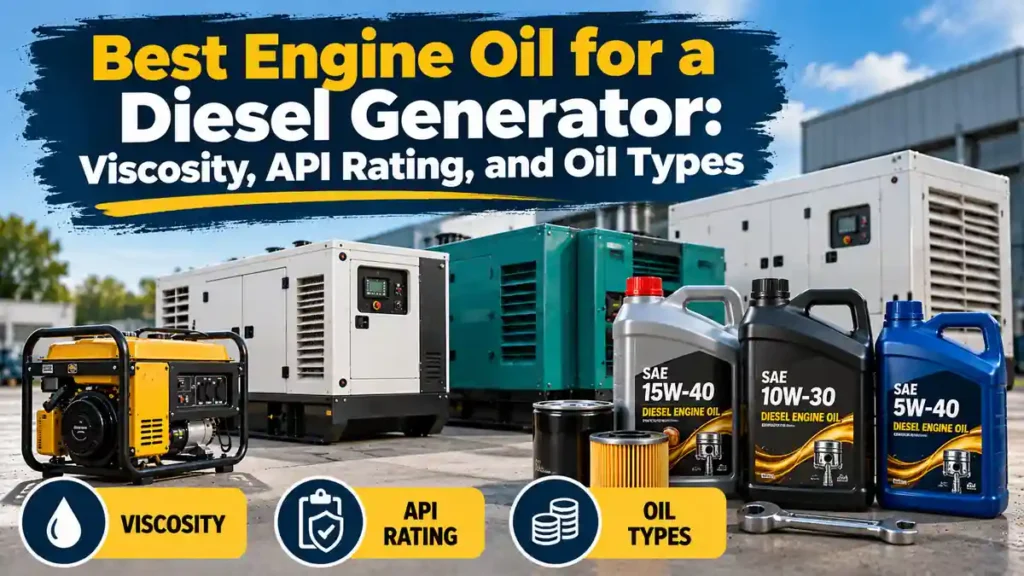


Quick answer: The best engine oil for a diesel generator is the oil that matches the engine manufacturer’s required SAE viscosity grade and API service category for your climate and operating conditions. For many modern four-stroke diesel generator engines, an API CK-4 heavy-duty diesel oil is a strong default when the manual allows it. SAE 15W-40 is common in warm and moderate climates, while 10W-30 or 5W-40 synthetic can be better in colder conditions. I never choose oil by viscosity alone—I check the manual, temperature range, emissions equipment, and service category together.
Meta description: Best engine oil for a diesel generator: learn the right SAE viscosity, API rating, synthetic vs conventional oil, climate ranges, and selection tips.
What Oil Should I Use in a Diesel Generator?
If you ask me what oil to use in a diesel generator, I start with three questions: What engine is in the generator? What temperatures will it operate in? What oil specification does the manual require?
That matters because two diesel generators of similar size can require different oils. A small air-cooled portable diesel generator may specify a different viscosity range from a 100 kW liquid-cooled standby unit. A modern Tier 4 engine with an exhaust aftertreatment system may also require a newer low-emission-compatible oil specification that an older mechanical-injection engine never needed.
So I do not recommend choosing oil only because the bottle says “diesel.” I want you to match viscosity, API category, manufacturer approval, and ambient temperature.


| What to Check | Why It Matters | Typical Example |
|---|---|---|
| SAE viscosity | Controls how easily oil flows cold and maintains film strength when hot | 5W-40, 10W-30, 15W-40 |
| API service category | Defines diesel-engine performance requirements | CK-4, CJ-4, CI-4 |
| Manufacturer approval | May be more specific than API alone | Cummins CES, Caterpillar ECF, OEM-specific spec |
| Ambient temperature | Changes cold-start flow and hot-running viscosity needs | Below 0°F may favor synthetic 5W-40 on some engines |
| Emissions equipment | DPF/SCR-equipped engines may need compatible low-ash chemistry | Modern CK-4 oil |
| Duty cycle | Long runs, heavy load, heat, dust, and frequent starts affect oil stress | Standby vs prime-power generator |
Best Diesel Generator Oil at a Glance
For a modern four-stroke diesel generator, I usually look first for a quality heavy-duty diesel engine oil carrying the correct manufacturer approval and an API category such as CK-4. Then I select the SAE grade based on the generator manual and expected temperature.
| Operating Situation | Common Oil Choice | Why |
|---|---|---|
| Warm to hot climate | 15W-40 if approved | Good high-temperature viscosity and very common heavy-duty diesel grade |
| Moderate climate | 10W-30 or 15W-40 if approved | Balances cold flow and hot protection |
| Cold winter operation | 5W-40 synthetic if approved | Improves cold cranking and oil circulation |
| Older diesel engine | Often 15W-40, but verify manual/API requirement | Many older industrial diesels were designed around heavier multigrade oil |
| Modern emissions-equipped diesel | CK-4 oil in OEM-approved viscosity | Designed for modern wear, oxidation, soot and aftertreatment demands |
| Very low temperature | 5W-30 or 5W-40 synthetic where permitted | Faster lubrication during cold starts |
These are selection examples, not universal specifications. Your engine manual always wins.
Understanding SAE Viscosity Grades
The viscosity number is one of the first things you see on an oil container: 15W-40, 10W-30, 5W-40, and so on. I think of viscosity as the oil’s resistance to flowing.
In a multigrade oil such as 15W-40, the number before the “W” describes low-temperature behavior. A lower first number generally means the oil flows more easily when cold. The second number describes viscosity behavior at normal high operating temperature.
That is why a 5W-40 and a 15W-40 can both provide a 40-grade high-temperature viscosity while behaving differently during a cold start.
| SAE Grade | Cold-Start Character | Hot-Running Character | Typical Use |
|---|---|---|---|
| SAE 30 | Poorer cold flexibility than a multigrade | 30-grade when hot | Some older engines in consistently warm climates |
| 10W-30 | Better cold flow than 15W-40 | 30-grade when hot | Moderate/cool climates where approved |
| 15W-40 | Common heavy-duty diesel cold performance | 40-grade when hot | Warm climates and many industrial diesels |
| 5W-30 | Very good cold flow | 30-grade when hot | Cold-weather applications where specified |
| 5W-40 | Excellent cold flow | 40-grade when hot | Cold-weather heavy-duty diesel use where approved |
Is 15W-40 the Best Oil for a Diesel Generator?
15W-40 is one of the most common heavy-duty diesel oil viscosities, and in many warm or moderate climates it is an excellent choice. But I would not call it automatically “the best” for every generator.
If your generator operates in a tropical or consistently warm environment, 15W-40 can make a lot of sense when the engine manufacturer approves it. It provides a strong lubricating film at operating temperature and is widely available in current heavy-duty diesel formulations.
But if the generator must start at very low temperatures, a 5W-40 synthetic may circulate faster during cranking. Some engines also specifically call for 10W-30 rather than 15W-40.
So the correct answer is: 15W-40 is often a very good diesel-generator oil, but only when the engine manual and temperature range support it.
10W-30 vs 15W-40 for a Diesel Generator
This is one of the most common comparisons I see. The main difference is not simply that one oil is “thicker.” The two grades behave differently across the temperature range.


| Feature | 10W-30 | 15W-40 |
|---|---|---|
| Cold flow | Better | Good, but not as strong in colder weather |
| Hot viscosity grade | SAE 30 | SAE 40 |
| Typical climate | Cool to moderate | Moderate to hot |
| Common industrial use | Increasingly common where OEM specifies it | Extremely common in heavy-duty diesels |
| Cold starting | Usually easier than 15W-40 | May crank more slowly in severe cold |
| Selection rule | Use whichever viscosity the engine manufacturer approves for your ambient temperature | |
What About 5W-40 Synthetic?
If I were preparing a diesel generator for severe winter weather, 5W-40 synthetic would be one of the first viscosities I would investigate—assuming the engine manual permits it.
The lower 5W winter rating improves flow during cold cranking. That matters because most engine wear occurs when surfaces are waiting for full oil circulation after startup. Faster cold-flow performance can also reduce starter and battery strain.
The 40-grade high-temperature rating means the oil can still provide the high-temperature viscosity characteristics expected from an SAE 40 multigrade.
Cummins, for example, recommends 5W-40 synthetic below 0°F (-18°C) for a current 6.7L diesel application while specifying CK-4 oil. That does not make the same rule universal for every generator, but it shows why temperature-based viscosity selection matters.
What Does API CK-4 Mean?
API CK-4 is a current heavy-duty diesel engine oil service category. The American Petroleum Institute describes CK-4 oils as suitable for high-speed four-stroke diesel engines, including modern emissions-era engines and many earlier engines when the manufacturer allows backward compatibility.
CK-4 oils are designed to address oxidation, shear-related viscosity loss, oil aeration, engine wear, piston deposits, soot-related viscosity increase, and protection of modern exhaust aftertreatment systems.
For many current diesel generator engines, CK-4 is the first API category I look for. However, I still verify the engine maker’s specification because the API category is only one part of the requirement.
| API Diesel Category | Status/Use | Important Note |
|---|---|---|
| CK-4 | Current heavy-duty diesel category | Common choice for modern four-stroke diesel engines |
| CJ-4 | Still listed for older emissions-era engines | CK-4 often exceeds earlier performance requirements, but verify OEM approval |
| CI-4 | Older category | Seen on older EGR-era engines |
| CH-4 | Older category | Common in older engine documentation |
| FA-4 | Current but specialized | Not interchangeable or backward-compatible with CK-4 unless the engine specifically approves FA-4 |
CK-4 vs FA-4: Do Not Assume They Are the Same
This is an important point. API FA-4 is not simply a “newer and therefore better” version of CK-4.
FA-4 was developed for selected newer on-highway diesel engines using certain XW-30 low-HTHS oils. API specifically warns that FA-4 is not interchangeable or backward-compatible with CK-4, CJ-4, CI-4, or CH-4 oils.
If your diesel generator manual calls for CK-4, I would not substitute FA-4 unless the engine manufacturer explicitly approves it. This is especially important for industrial and generator applications because many of them were never designed around FA-4 viscosity requirements.
Can I Use Synthetic Oil in a Diesel Generator?
Yes, in many diesel generators you can use synthetic oil if it meets the required viscosity and engine performance specification. In cold climates, synthetic oil can be especially useful because it tends to maintain better low-temperature flow.
But “synthetic” is not a replacement for the required specification. A premium synthetic oil with the wrong API category or viscosity can still be the wrong oil for your generator.
I look at oil in this order:
- Engine-manufacturer specification.
- Required API or equivalent performance category.
- SAE viscosity for the expected temperature.
- Conventional, synthetic blend, or full synthetic formulation.
Conventional vs Synthetic vs Synthetic Blend
| Oil Type | Advantages | Limitations | Good Fit |
|---|---|---|---|
| Conventional | Lower cost, widely available | Less cold-flow and oxidation margin than many synthetics | Mild climates and normal service where approved |
| Synthetic blend | Middle ground in price and performance | Performance varies by formulation | Moderate severe-duty use |
| Full synthetic | Excellent cold flow, oxidation resistance, temperature stability | Higher purchase price | Cold weather, high heat, severe duty, long runtime where approved |
Does Synthetic Oil Let Me Extend the Oil-Change Interval?
Not automatically. I would never double an oil-change interval just because I switched to synthetic oil.
The generator manufacturer sets the service interval based on engine design, oil capacity, filtration, fuel quality, load, dust, temperature, soot and other operating factors. Synthetic oil may tolerate heat and oxidation better, but that does not eliminate contamination from soot, fuel dilution, acids or debris.
If you want the detailed hour-based schedule, see my guide on diesel generator oil change hours.
Best Oil for Hot-Weather Diesel Generator Operation
High ambient heat increases oil stress. If the manual approves 15W-40 for your engine and climate, it is often a practical choice for warm environments. Many heavy-duty diesel formulations are designed around sustained high-temperature operation.
But high ambient temperature is not the only factor. A generator installed in an enclosure with poor ventilation may expose its engine oil to far more heat than the outdoor temperature suggests. Overloading, dirty cooling systems and restricted airflow can compound the problem.
If your generator is running unusually hot, choosing thicker oil is not a substitute for solving the actual cooling problem. My diesel generator overheating guide explains what to check.
Best Oil for Cold-Weather Diesel Generator Operation
Cold weather is where viscosity choice becomes obvious. Thick oil increases cranking resistance and takes longer to reach critical engine surfaces.
For engines that approve it, a 5W-40 full synthetic or another low-winter-number oil can make starting easier and improve lubrication during the first seconds after startup.
You should also consider battery condition, glow plugs or intake heaters, fuel gelling, and coolant heaters. Oil is only one part of reliable winter starting. See my winter maintenance guide for diesel generators for the full cold-weather checklist.
Ambient Temperature and Viscosity Example
The exact ranges depend on the engine manual, but this simplified table shows how I think about viscosity selection.
| Ambient Temperature | Oil to Investigate First | Reason |
|---|---|---|
| Below -20°F (-29°C) | OEM-approved low-temperature synthetic | Extreme cold requires excellent pumpability |
| -20°F to 0°F (-29°C to -18°C) | 5W-30 or 5W-40 if approved | Strong cold-start performance |
| 0°F to 32°F (-18°C to 0°C) | 5W-40 or 10W-30 if approved | Balances cold flow with operating protection |
| 32°F to 100°F (0°C to 38°C) | 10W-30, 10W-40 or 15W-40 depending on manual | Common generator operating range |
| Above 100°F (38°C) | Often 15W-40 or OEM-approved high-temperature grade | Maintains viscosity in sustained heat |
Again, treat this as a general comparison, not a replacement for the engine’s official viscosity chart.
What If My Diesel Generator Manual Calls for an Older API Rating?
Older diesel generator manuals may mention CH-4, CI-4, CJ-4 or even older categories. API states that CK-4 exceeds the performance criteria of several earlier diesel categories, but diesel-category backward compatibility is not as simple as gasoline-engine oil compatibility in every case.
I check the manufacturer documentation before substituting a newer oil, especially on very old engines, unusual fuel systems, vintage military generators or engines with specific additive requirements.
Does Oil Brand Matter?
Brand matters less to me than specification compliance, authenticity and consistency. I would rather use a correctly licensed oil from a reputable manufacturer that meets the exact engine requirement than choose a famous brand in the wrong viscosity or API category.
When comparing two oils, I check:
- SAE viscosity grade.
- API diesel service category.
- OEM approvals printed on the product data sheet.
- Whether it is intended for heavy-duty diesel service.
- Whether the product is compatible with DPF/SCR/EGR equipment if applicable.
- Whether the container appears genuine and properly sealed.
Can I Use Automotive Diesel Oil in a Generator?
Sometimes yes. A heavy-duty engine oil can be suitable for both road-going diesel engines and industrial generator engines if it meets the generator engine’s required specification.
The important distinction is not “automotive” versus “generator” printed on the front label. The important information is on the specification sheet and API/OEM approvals.
However, some stationary industrial engines have special requirements, so I always confirm the engine model rather than assuming a truck oil is automatically correct.
Can I Use Gasoline Engine Oil in a Diesel Generator?
I would not use a gasoline-only oil unless the diesel generator manufacturer specifically allows it. Diesel oils must handle soot loading, diesel combustion byproducts and heavy-duty operating conditions that differ from most gasoline engines.
Some oils carry both diesel and gasoline categories on the same API label—for example a diesel “C” category plus a gasoline “S” category. That is different from using an oil that only carries a gasoline rating.
Can I Mix 10W-30 and 15W-40?
In an emergency, topping up with a compatible oil is generally better than running the engine below the safe oil level. But I do not recommend routinely mixing viscosities if you can avoid it.
Mixing oils can leave you with an unknown final viscosity and additive balance. At the next oil change, I would drain the mixed oil and refill with one approved product at the correct grade.
Can the Wrong Oil Cause Low Oil Pressure?
Yes. Oil that is too thin for the engine and operating temperature can contribute to lower hot oil pressure, especially in a worn engine. Fuel dilution, overheating and excessive bearing clearance can cause similar symptoms.
If you are dealing with an oil-pressure warning rather than simply selecting oil, see my detailed guide to diesel generator low oil pressure.
How Much Oil Does a Diesel Generator Take?
Oil capacity varies enormously. A small portable diesel engine may hold only a few quarts or liters, while a large industrial generator can require many gallons.
I never estimate oil capacity from generator kW alone. Two generators with the same electrical rating can use different engines and oil pans.
| Generator Class | Possible Oil Capacity Pattern | What I Recommend |
|---|---|---|
| Small portable diesel | Often a few quarts/liters | Check engine manual and dipstick |
| Small standby diesel | Several quarts to a few gallons | Use exact engine specification |
| Commercial 50–200 kW | May require multiple gallons | Use service manual capacity including filter |
| Large industrial genset | Can require many gallons | Confirm sump capacity and filter replacement quantity |
Do Not Overfill the Engine
More oil is not better. Overfilling can cause crankshaft aeration, foaming, increased crankcase pressure, oil consumption and seal problems.
I fill to the manufacturer’s specified level, run the engine only as directed, let the oil settle, and recheck on level ground. The dipstick—not an estimate from the container—is the final check.
Oil Choice for Standby vs Prime-Power Generators
A standby generator may sit for long periods and then suddenly run at substantial load. A prime-power generator may operate for many hours every day. The correct oil specification may be the same, but the duty cycle affects how hard the oil works.
| Duty | Oil Stress | What I Watch |
|---|---|---|
| Emergency standby | Long idle periods, condensation, sudden full-load operation | Calendar-based oil changes and exercise schedule |
| Prime power | Long continuous runtime and sustained heat | Hour-based service intervals and oil analysis |
| Construction/rental | Dust, vibration, varying load, frequent transport | Shorter service interval under severe conditions |
| Cold-climate standby | Cold cranking and delayed oil flow | Approved low-temperature viscosity and battery health |
Should I Use Oil Additives?
Normally, no. A quality API-licensed diesel engine oil already contains a carefully balanced additive package including detergents, dispersants, anti-wear chemistry, oxidation inhibitors and other components.
Adding aftermarket oil treatments can alter that balance and may conflict with engine-manufacturer recommendations. Unless the engine manufacturer specifically recommends an additive, I use the correct oil and leave the chemistry alone.
How I Choose Diesel Generator Oil Step by Step
- Find the exact engine model. I check the data plate, not just the generator brand.
- Open the current engine or genset manual. I look for the lubrication section.
- Identify the required API/OEM category. For many modern diesels this may be CK-4, but I verify it.
- Check the ambient-temperature viscosity chart. This determines whether 15W-40, 10W-30, 5W-40 or another grade fits.
- Consider severe duty. Heat, dust, long runtime, cold starts and high loads matter.
- Choose a reputable licensed oil. I verify the label and product data sheet.
- Replace the oil filter when required. Fresh oil with an overdue filter is not a complete service.
- Record the date and hour-meter reading. This prevents missed maintenance.
Common Oil-Selection Mistakes
- Buying oil because the bottle simply says “diesel.”
- Assuming 15W-40 is correct for every climate.
- Using FA-4 in an engine that only approves CK-4.
- Changing to thicker oil to hide low oil pressure.
- Using a synthetic oil but ignoring the required API category.
- Extending oil-change hours without OEM approval.
- Overfilling the crankcase.
- Using two-stroke oil in a four-stroke diesel generator.
- Ignoring the oil filter during an oil change.
- Using oil from an unsealed or questionable container.
Signs the Oil May Be Wrong or Worn Out
Oil appearance alone cannot tell you everything, but I pay attention to changes in oil pressure, starting behavior and consumption.
| Symptom | Possible Oil-Related Cause | Other Causes to Check |
|---|---|---|
| Low hot oil pressure | Oil too thin, degraded oil, fuel dilution | Worn bearings, pump, sensor fault |
| Hard cold cranking | Oil too viscous for temperature | Weak battery, starter, fuel gelling |
| High oil consumption | Wrong grade or volatility | Rings, valve guides, turbo seals, leaks |
| Oil thickening | Oxidation or soot loading | Overdue service, poor combustion |
| Oil level rising | Fuel or coolant contamination | Injector leak, internal coolant leak |
| Oil-pressure shutdown | Low level, wrong viscosity | Sensor, wiring, pump or mechanical wear |
How Often Should I Check the Oil?
For generators that operate regularly, I check the oil level before operation or according to the OEM maintenance schedule. Some portable generator manuals call for checking before each use or after a specified number of running hours.
For standby systems, I also check for leaks, coolant contamination and unusual oil level changes during routine inspections. If you need a broader maintenance schedule, see how often diesel generators should be serviced.
Can Better Oil Fix an Old or Worn Generator?
Better oil can improve protection, but it cannot repair worn bearings, weak compression, a failing oil pump, leaking seals or damaged cylinder walls.
If a generator suddenly develops low pressure, metal noise, excessive blue smoke or high oil consumption, I diagnose the mechanical problem rather than trying progressively thicker oils.
For a broader symptom checklist, see common diesel generator problems.
FAQ: Best Engine Oil for a Diesel Generator
Is 15W-40 good for a diesel generator?
Yes, 15W-40 is an excellent and widely used heavy-duty diesel viscosity for many generator engines in moderate and warm climates. Use it only if your engine manufacturer approves that grade for your temperature range.
Is 10W-30 better than 15W-40?
Neither is universally better. 10W-30 generally offers better cold-flow performance, while 15W-40 provides a 40-grade high-temperature viscosity. The correct choice depends on the engine manual and ambient temperature.
Can I use 5W-40 synthetic in my diesel generator?
Yes, if the engine manufacturer approves 5W-40 and the oil meets the required diesel API/OEM specification. It is especially useful in cold climates.
What API rating should diesel generator oil have?
Many modern four-stroke diesel engines use API CK-4 oil, but older engines may list CJ-4, CI-4, CH-4 or a manufacturer-specific requirement. Check the exact engine manual.
Is API FA-4 better than CK-4?
No. FA-4 is a specialized category for selected engines and is not backward-compatible with CK-4. Do not use FA-4 unless the engine manufacturer specifically approves it.
Should I use synthetic oil in a standby generator?
Synthetic oil can be beneficial for cold starts, high heat and oxidation resistance, but it still has to meet the correct SAE and API/OEM specifications. It does not automatically allow longer service intervals.
Can I use SAE 30 in a diesel generator?
Some older generator engines permit straight SAE 30 in consistently warm temperatures. Multigrade oils usually provide better temperature flexibility. Follow the manual.
What happens if generator oil is too thick?
Oil that is too thick for the ambient temperature can increase cranking resistance and delay lubrication during startup, especially in cold weather.
What happens if generator oil is too thin?
Oil that is too thin for the engine and operating temperature may reduce oil-film strength and contribute to low hot oil pressure. The correct viscosity should come from the OEM chart.
Can I switch from conventional to synthetic oil?
Usually yes if the synthetic product meets the engine’s required viscosity and performance specification. On an older leaking engine, however, I would inspect seals and oil consumption closely after any lubricant change.
Final Thoughts
If you want the best engine oil for a diesel generator, I would not start with a brand name. I would start with the engine data plate and the manual.
For many modern diesel generator engines, a quality API CK-4 heavy-duty diesel oil is a sensible performance category to look for. 15W-40 is extremely common in warm and moderate climates, 10W-30 may be specified for cooler conditions or certain newer engines, and 5W-40 synthetic can be an excellent cold-weather choice when approved.
The safest rule is simple: match the OEM specification first, then choose the viscosity for your climate. That approach protects oil pressure, cold-start lubrication, turbocharger bearings, piston rings and the rest of the engine far better than choosing oil based on price, brand reputation or the thickest viscosity on the shelf.